Stories
Exped: Sleeping mats, R-values, backpacks and tents explained
In partnership withExped
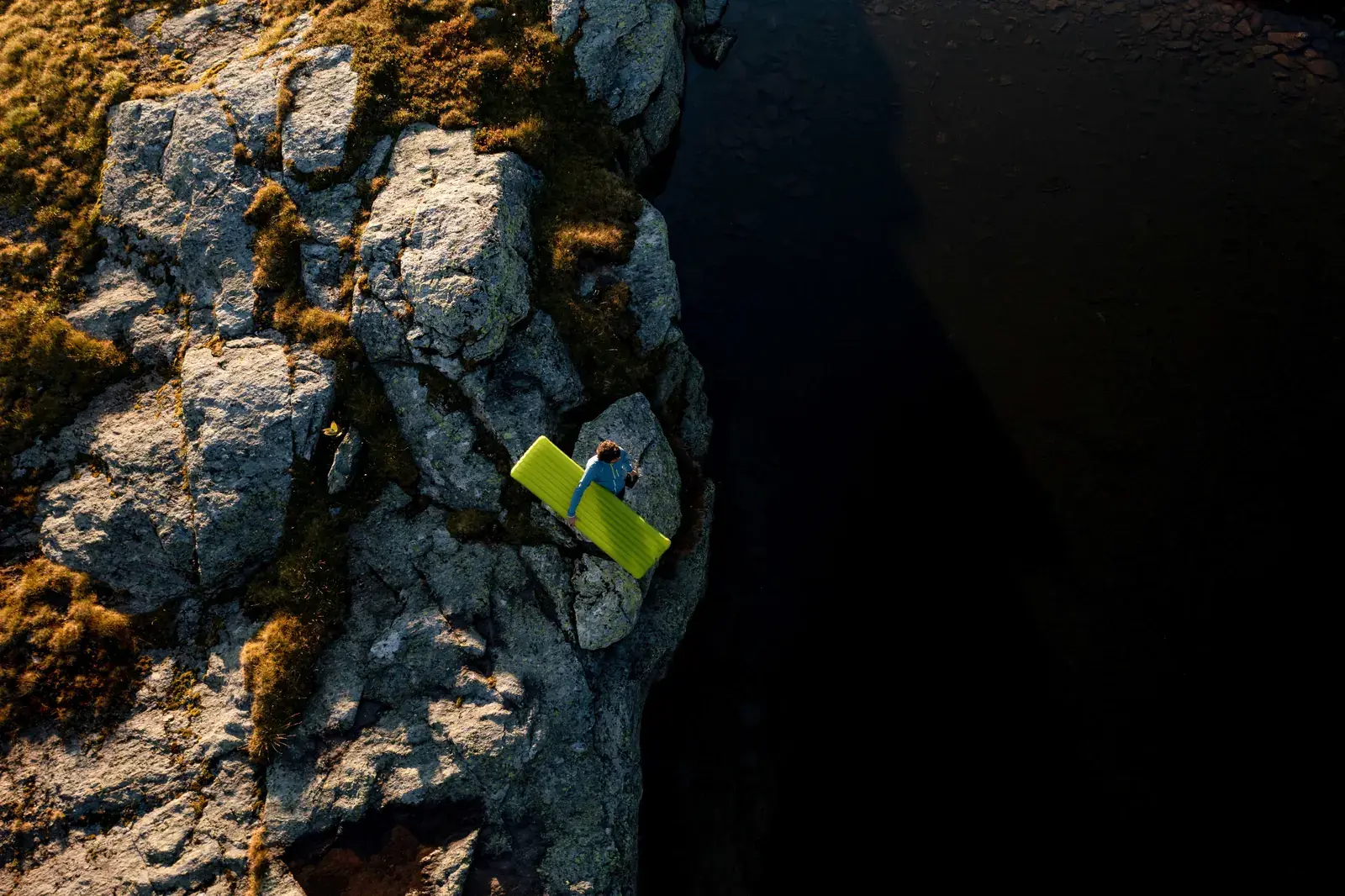
From nine months in a Canadian wilderness log cabin to Swiss gear engineering in Zurich: how Exped structures its Ultra, Dura, Versa and MegaMat sleeping mats by ASTM R-value, how its roll-top packs and tents compare, and how to pick M, MW or LW sizes.
The essentials at a glance
- 01
Heidi and Andi Brun founded Exped AG in Zurich in 1983 after spending nine months in a self-built log cabin in northern Canada in 1980/81; the Swiss company has engineered its own outdoor gear since 1997.
- 02
With the down-insulated DownMat (2002) and synthetic SynMat (2006), Exped reshaped cold-weather air mats. Today the range splits into four families: Ultra (minimum pack weight), Dura (75 D / 170 D abrasion protection), Versa (integrated hand pump) and MegaMat (3D foam for vans and basecamps).
- 03
Numbers carrying an "R" suffix indicate thermal resistance measured under the international ASTM F3340 standard, stepping from 1R for warm summer nights through 3R and 4.5R up to 6.5R, 8R and 10R for sub-zero expeditions.
- 04
Beyond sleep systems, Exped builds stripped-back roll-top backpacks such as Lightning, Icefall, Whiteout and Black Ice, storm-worthy tents and waterproof drybags led by the dual-use Schnozzel Pumpbag.
Campers who wake up shivering in October almost always blame their sleeping bag first. Most of the time, the real culprit lies right underneath them. Body weight crushes down or synthetic fill beneath your hips and shoulders to a few millimetres, eliminating dead air space so cold ground drains warmth directly through the tent floor. Solving that conductive heat loss is what put Exped on the map.
Rather than hiding specs behind marketing names, the Zurich-based brand labels its gear around use case, R-value and volume: Ultra 3R, Ultra 6.5R, Dura 10R, Versa 4.5R, MegaMat Duo, Lightning 50 or Icefall 40. Once you read the logic linking shell denier, internal insulation and mat width, choosing between a featherweight backpacking pad and a 10-centimetre camper mattress takes seconds.
Exped's design philosophy grew out of an unusual honeymoon in late summer 1980. Heidi and Andi Brun flew from Zurich into the boreal wilderness of northern Canada near the Arctic Circle carrying an axe, a saw blade and roughly 40 per cent of the food they would need. Before winter locked in, they built a small log cabin by hand, weathered temperatures down to minus 40 degrees Celsius, lived off the land for nine months and dismantled the cabin completely before a floatplane picked them up so no trace remained. That experience shaped the company's guiding principle: maximum outdoor experience with minimal means.
Back in Switzerland, the couple founded Exped AG (short for Expedition Equipment) in Zurich in 1983. For fourteen years they worked as a specialist European distributor for technical outdoor brands, gathering constant field feedback from climbers, paddlers and trekkers. In 1997 Exped stepped into manufacturing its own designs, starting with the ridge-tunnel Orion tent.
Global recognition arrived a few years later through sleep systems. Until the early 2000s, inflatable air mattresses were notoriously cold in mountain camps because internal air convected heat straight into frozen ground. Exped launched the first down-filled air mat, the DownMat, in 2002, followed in 2006 by the SynMat with microfibre fleece welded to both top and bottom chambers. Alongside them came a signature dual-purpose tool: the Exped Schnozzel, a waterproof roll-top sleeping bag stuff sack that snaps onto the mat valve to inflate high-volume pads in seconds without blowing damp breath inside. According to Exped, all products carry a five-year warranty on materials and workmanship backed by in-house repair workshops, and since 2025 its entire textile range has been produced without intentionally added PFAS.
Exped organises its current sleeping pads along two axes. The family name tells you the shell fabric and intended terrain; the number followed by "R" states the warmth class. Thermal resistance is measured in independent laboratories under the ASTM F3340 standard, making ratings directly comparable across brands: R-values around 1 to 2 cover warm summer nights, 3 to 4.5 handle spring through autumn, 5 and above enter true four-season territory, and ratings past 8 insulate on snow and glacier ice.
Every inflatable Exped mat runs air baffles lengthwise from head to toe, with slightly thicker outer rails that keep you centred through the night. Low-profile PU FlatValves separate inflation (fitted with a one-way flap for easy pressure tuning) from rapid deflation.
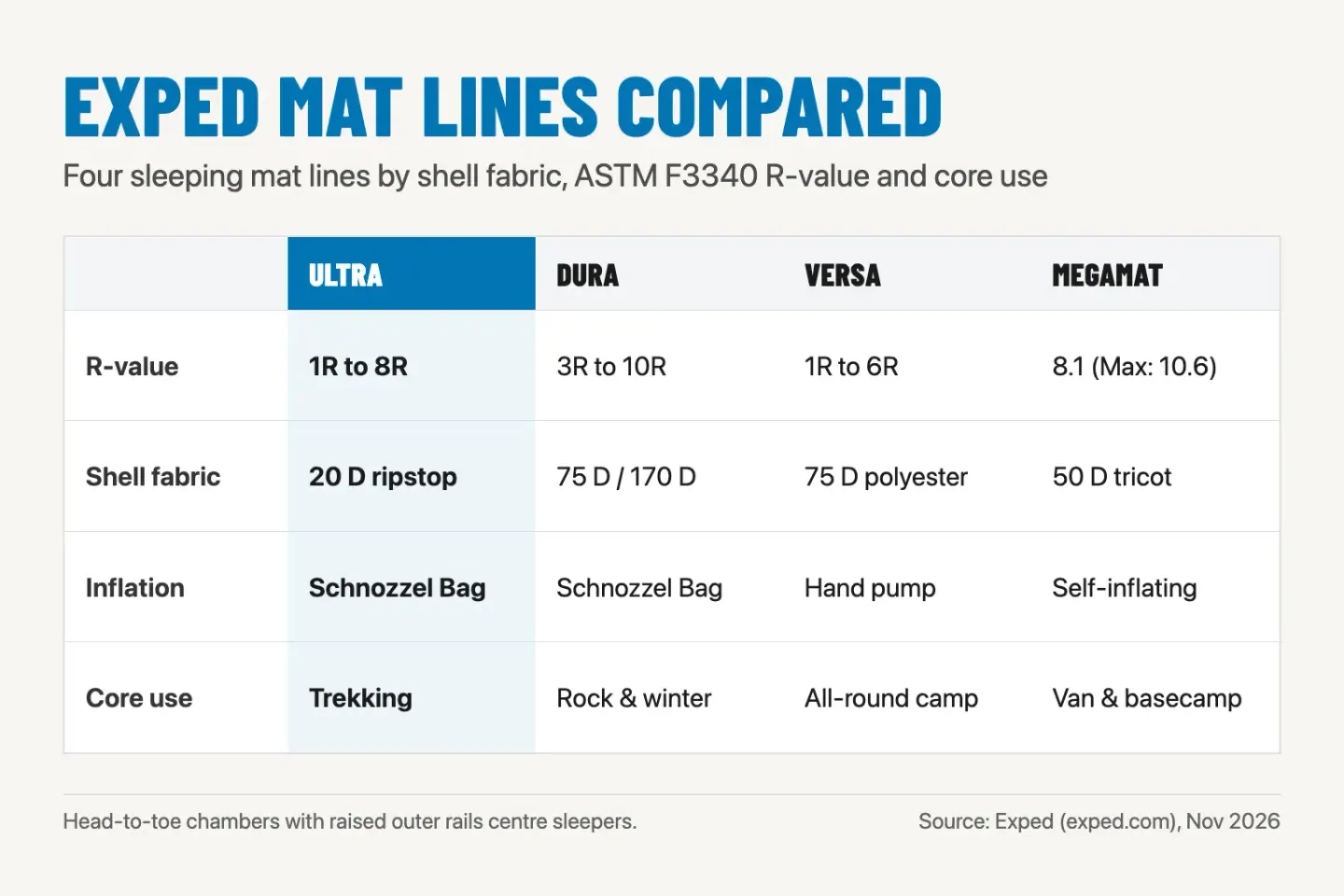
Ultra (1R to 8R): lowest weight for trekking, bikepacking and alpine routes
Whenever every gram in a backpack or bikepacking frame bag counts, look to the Ultra series. According to Exped, the shell uses lightweight 20-denier ripstop polyester made from 100 per cent post-consumer recycled material (bluesign approved), and a Schnozzel Pumpbag comes included in the box.
- Warm summer trips (1R): The Exped Ultra 1R skips internal fleece, relies purely on air chambers (ASTM R-value 1.3) and packs down to the size of a water bottle.
- Three-season trekking (3R): Standing 7 centimetres thick, the Exped Ultra 3R (ASTM R-value 3.2, around 465 g in size M) welds Texpedloft microfibre to top and base, and also comes as a two-person Exped Ultra 3R Duo with independent halves.
- All-season and winter cold (6.5R & 8R): The 9-centimetre Exped Ultra 6.5R (ASTM R-value 6.9, around 440 g rectangular or 354 g as the tapered Ultra 6.5R Mummy) pairs microfibre insulation with internal reflective film under SynMat Plus construction. Deep winter bivouacs call for the Exped Ultra 8R at an ASTM R-value of 8.8. Pairing an air mat with the folding closed-cell Exped Flex 3R foam pad adds instant puncture insurance on sharp scree.
Dura (3R to 10R) and Versa (1R to 6R): tough shells and built-in pumps
Rough ground calls for thicker fabric. For rocky alpine ledges, canoe expeditions, scout camps or dogs sharing a vestibule, the Dura family combines a 75-denier top with an abrasion-resistant 170-denier base fabric (recycled polyester according to Exped). The Exped Dura 3R weighs 705 grams in size M at 7 centimetres thickness (R-value 3.2), while couples get four-season protection in the Exped Dura 6.5R Duo. At the polar and high-altitude end sits the 10-centimetre Exped Dura 10R, delivering an ASTM R-value of 10 using 700-cuin down certified to the Responsible Down Standard (RDS) according to Exped.
Campers who prefer an all-in-one setup without carrying a separate pump bag can pick the Versa range, built from 75-D polyester all round with a two-handed push pump integrated into the mat. The 7.5-centimetre Exped Versa 4.5R reaches an ASTM R-value of 4.4 (660 g in size M), stretching comfortably from spring through chilly autumn nights. For softer skin feel, the Exped Versaluxe adds a removable, machine-washable cover.
MegaMat, DeepSleep and SIM: 3D foam comfort for vans and basecamps
Once a car boot, campervan or basecamp tent carries the load, Exped shifts from baffled air tubes to vertical-walled 3D open-cell foam cores that stay level right to the edges.
The flagship Exped Megamat and double-width Exped Megamat Duo pair 10 centimetres of cored foam with a stretch 50-D tricot surface for an R-value of 8.1. Tailored wheel-arch cutouts let the Exped Megamat Auto and wool-insulated Exped Luxemat Auto slot cleanly into estate cars, SUVs and vans. Stepping up to 15 centimetres of foam, the Exped Megamat Max hits an R-value of 10.6, whereas the 7.5-centimetre Exped Deepsleep Mat (R-value 9) and classic Exped SIM 3.8 pack smaller for tighter trunks.
Exped builds backpacks with the same stripped-down discipline as its mats: clean silhouettes that do not snag on rock or branches, modular straps you can remove to save weight, and bright white or light-coloured interiors so small items stand out inside a dim hut.

For multi-day treks and thru-hikes, the Exped Lightning 50 (and compact Lightning 40) stands out for its load-to-weight ratio. Weighing around 1,155 grams minimum in S/M, its stepless T-Rex suspension uses a single central aluminium stay bolted to the lumbar pad to carry up to 22 kilograms while leaving shoulders and hips free to twist on rough trails. Travellers and trekkers who prefer a traditional top lid, front U-zip access and ventilated back panel can step into the Exped Ridgeline 65 or Ridgeline 55.
Exped backpack families compared
| Feature | Lightning 40 / 50Trekking pick | Icefall 30 / 40 / 50 | Black Ice & Whiteout | Cloudburst & Torrent |
|---|---|---|---|---|
Primary terrain | Multi-day trekking & thru-hikes | Alpine climbing & ski touring | Rock, ice & winter mountaineering | Day hikes, bike & commuting |
Closure & entry | Roll-top + stretch side pockets | Roll-top + full side zipper | Waterproof roll-top | Waterproof roll-top |
Shell focus | Lightweight water-repellent nylon | Tear-resistant UHMPE ripstop | TPU-laminated nylon (10,000 mm) | Seam-taped waterproof fabric |
Standout detail | Central stay carries up to 22 kg | Dedicated avalanche safety pocket | Removable hip belt & back pad | Packable build / laptop sleeve |
Steep snow, mixed climbs and ski tours belong to the Exped Icefall 40 (strippable to 670 g in size M, 940 g full weight). Its ultra-high-molecular-weight polyethylene (UHMPE) ripstop fabric (bluesign certified according to Exped) shrugs off ski edges and crampon points, a front safety compartment organises shovel and probe, and a side zip reaches deep into the main body. Where total weather sealing matters most, the seam-welded Exped Black Ice 30 (plus Black Ice 45) and winter-armoured Exped Whiteout 45 keep meltwater out without a liner, while the Exped Verglas 40 Wmns (and Verglas 40) pairs a compact top lid with side access. For wet bike commutes and summit dashes, the packable Exped Cloudburst 15 and Exped Torrent 30 seal out rain via taped seams.
Tents launched Exped's manufacturing era in 1997, and fast, dry pitching in foul weather remains a core strength. In the two-person Exped Venus II UL (2.1 kg minimum weight, 2.85 m² floor plus two 1.1 m² vestibules), hybrid ridge-and-tunnel pole geometry creates vertical side walls and freestanding stability; external pole sleeves link canopy and flysheet so both pitch simultaneously without soaking the inner tent in rain. Full four-season storm duty goes to the three-person tunnel Exped Ceres III XP Extreme.

Campers craving living space without expedition weight turn to the Exped Outer Space III: exoskeletal poles suspend a 3.8-square-metre front vestibule with 140 centimetres of headroom, tall enough to sit out a downpour on camp chairs. Lighter backpackers can choose the Exped Lyra III Extreme dome tent (1.85 kg minimum weight), the compact Exped Vega 2 or the versatile Exped Tarp Versa.
Sleeping bags and small camp accessories complete the modular system: the Exped Ultra 0° down bag trims bulk on summer treks, the roomy Exped Comfort -10C 15F unzips flat into a quilt, and the wearable Exped Dreamwalker doubles as an insulated camp coat around morning coffee. Cold toes warm up inside Exped Down Sock booties or Exped Camp Slipper hut shoes, the Exped Chair Kit turns a sleeping pad into a camp lounger, and colour-coded Exped Drybag Versa roll-top sacks keep spare layers bone dry.
Six core Exped picks from our range
From featherweight Ultra air mats and 10 cm MegaMat Duo comfort to UHMPE alpine packs and tents
 ExpedUltra 6.5RNine-centimetre all-season air mat (ASTM R-value 6.9) in 20 D ripstop polyester, supplied with Schnozzel Pumpbag.179.25€View product →
 ExpedUltra 3RLightweight 3-season trekking mat (7 cm thick, R-value 3.2) insulated with welded Texpedloft microfibre.171.45€View product →
 ExpedDura 3RRugged 3-season sleeping mat combining a 75 D top and 170 D base for rocky camps and heavy use.156.05€View product →
 ExpedMegamat DuoSelf-inflating 10 cm double mat (R-value 8.1) with vertical 3D foam walls built for campervans and basecamps.311.85€View product →
 ExpedIcefall 40Weather-resistant alpine and ski-touring backpack in tear-resistant UHMPE ripstop with side zip and avalanche pocket.421.05€View product →
 ExpedOuter Space IIIThree-person tent offering 140 cm headroom and a convertible 3.8 m² vestibule for wet-weather living space.662.85€View product →
Exped's colour-coded mat families make choosing straightforward, yet pushing weight savings too far carries real field consequences. Shaving 250 to 350 grams with a 20-denier Ultra 3R or Ultra 6.5R pays off inside a tent, whereas sharp granite grit, desert thorns or stray campfire sparks can puncture thin 20-D shells quickly if you cowboy-camp without a groundsheet or foam pad. At the opposite extreme, MegaMat and MegaMat Max weigh roughly 2.5 to over 5 kilograms and roll into bulky cylinders meant strictly for vehicles, boats or basecamps.
Inflation technique matters just as much. According to Exped, you should avoid inflating insulated down or synthetic air mats repeatedly by mouth: warm exhaled moisture condenses inside the baffles, reducing loft and inviting mildew over time. Use the Schnozzel Pumpbag, a Mini Pump or the low-pressure Exped Ultra Pump instead, and never attach high-pressure air compressors that can rupture internal welds.
Matching the right Exped setup to your trip
- 1
If you count every gram on multi-day hikes or bikepacking routes
pick Ultra 3R (3-season) or Ultra 6.5R (all-season) in 20 D ripstop with the Schnozzel Pumpbag.
- 2
If you pitch on rough rock, camp in deep winter or bring a dog into the vestibule
step up to Dura (3R to 10R) with its 75 D top and 170 D base rather than thin Ultra fabric.
- 3
If you want an uncomplicated mat with no separate pump sack to pack
choose Versa 4.5R with its built-in two-handed pump.
- 4
If you sleep in a campervan, estate car or family tent and want home-bed support
go straight to MegaMat, MegaMat Auto or the 15 cm MegaMat Max.
Right for you if …
Trekkers, alpinists, bikepackers and van campers who value verified ASTM F3340 R-values, compact pack size and repairable construction
Probably not for you if …
Cowboy camping on thorny ground with an unprotected 20 D Ultra mat, or strapping a 10 cm MegaMat onto a backpacking pack
Exped splits mat sizes cleanly by length and width so side sleepers do not drop elbows onto cold tent floors:
- M (Medium): approx. 183 × 52 cm, standard length and slim width for sleepers up to roughly 180 cm tall.
- MW (Medium Wide): approx. 183 × 65 cm, matching Medium length while adding 13 centimetres of shoulder and knee room for active or side sleepers.
- LW (Long Wide): approx. 197 × 65 cm, extra length paired with full 65 cm width for taller campers up to roughly 195 cm.
- Duo (M Duo / LW Duo): double mats built with two independent air chambers so one person turning over does not bounce the other.
Sleeping bags follow body-height brackets from Small (up to 170 cm) and Medium (up to 180 cm) through Long (up to 195 cm) to Extra Long (up to 210 cm).
Following Exped's official care rules adds years to any mat's service life:
- Cleaning: Close all valves firmly, wipe the shell by hand using warm water, mild soap and a soft sponge, rinse clean and air-dry completely. Never place a sleeping mat in a washing machine or tumble dryer.
- Home storage: Store both insulated air mats and self-inflating MegaMats unrolled with valves open in a cool, dry space out of sunlight, such as flat under a bed or behind a wardrobe. That lets trace moisture escape and preserves foam rebound in self-inflating cores.
- Warm-weather pressure: Sealed air expands sharply inside a sun-baked tent or rooftop box during the day. Crack the valve slightly in the morning to prevent over-inflation stress on internal baffles.
- Field repairs: Carry the Exped Field Repair Kit with textile glue and TPU patches for lasting trail fixes; skip duct tape or standard bicycle inner-tube cement.
Explore the full Exped range
From Ultra, Dura, Versa and MegaMat sleeping pads to roll-top backpacks, tents, sleeping bags and waterproof drybags.
Shop all Exped gearFrequently asked questions
What do Ultra, Dura, Versa and the R-numbers mean on Exped sleeping mats?
The series name defines shell durability and use case: Ultra uses lightweight 20 D ripstop polyester for human-powered trips, Dura pairs a 75 D top with a tough 170 D base for abrasive ground, and Versa uses 75 D polyester with a built-in hand pump. The number plus "R" (1R, 3R, 4.5R, 6.5R, 8R or 10R) indicates the warmth class based on independent ASTM F3340 R-value measurements: higher numbers block more ground cold.
Which R-value do I need for summer, three-season or winter camping?
Frost-free summer nights need an R-value between 1 and 2 (such as Ultra 1R). Three-season hiking from spring through autumn calls for an R-value around 3 to 4.5 (Ultra 3R, Dura 3R or Versa 4.5R). Year-round trips, snow camps and sub-zero temperatures require an R-value of 5 or higher, covered by Ultra 6.5R (ASTM 6.9), Ultra 8R (ASTM 8.8), MegaMat (8.1) or Dura 10R (10).
What is the difference between Exped M, MW and LW mat sizes?
M stands for Medium (typically 183 × 52 cm) and fits back sleepers up to around 180 cm tall. MW stands for Medium Wide (183 × 65 cm), keeping the 183 cm length while adding 13 centimetres of width so side sleepers keep knees and elbows on the pad. LW means Long Wide (197 × 65 cm), pairing extra length with the 65 cm wide cut for sleepers up to around 195 cm.
Can I inflate an Exped sleeping mat by mouth?
Only in an emergency. Exped advises against regular mouth inflation on insulated mats because warm breath carries moisture into the microfibre or down fill, where it condenses in cold weather, lowers thermal efficiency and can cause mould during storage. Use the Schnozzel Pumpbag, a Mini Pump or Versa's integrated hand pump for dry inflation.
How should I store my Exped mat between trips?
Make sure the mat is clean and completely dry, then store it unrolled (flat or loosely laid out) with all valves open in a cool, dry room away from direct sun and pets. Leaving self-inflating models like MegaMat, DeepSleep or SIM unrolled keeps the open-cell foam expanded so it self-inflates rapidly at camp.
Sources (6)
- Exped company history: From northern Canada in 1980 to Exped AG ↗
- Exped about us: Vision and Swiss engineering in Zurich ↗
- Exped sleeping mats overview: Ultra, Dura, Versa and MegaMat ↗
- Exped backpacks: Lightning, Icefall, Whiteout and Black Ice ↗
- Exped tents and tarps: Venus, Outer Space, Lyra and Ceres ↗
- Exped 5-year warranty and in-house repair workshops ↗

SportFits editorial team
Marketing & Sales Manager at SportFitsNiklas is Marketing & Sales Manager at SportFits and studied applied sports science in Regensburg. In the magazine he writes about training science, fitness and longevity, putting trends into scientific context instead of simply celebrating them. He also looks at what really matters in outdoor gear: honest facts instead of empty advertising language.
Author profile →SportFits
outdoors looks good on you