Stories
Bollé: Ski helmets, goggles and visor helmets explained
In partnership withBollé
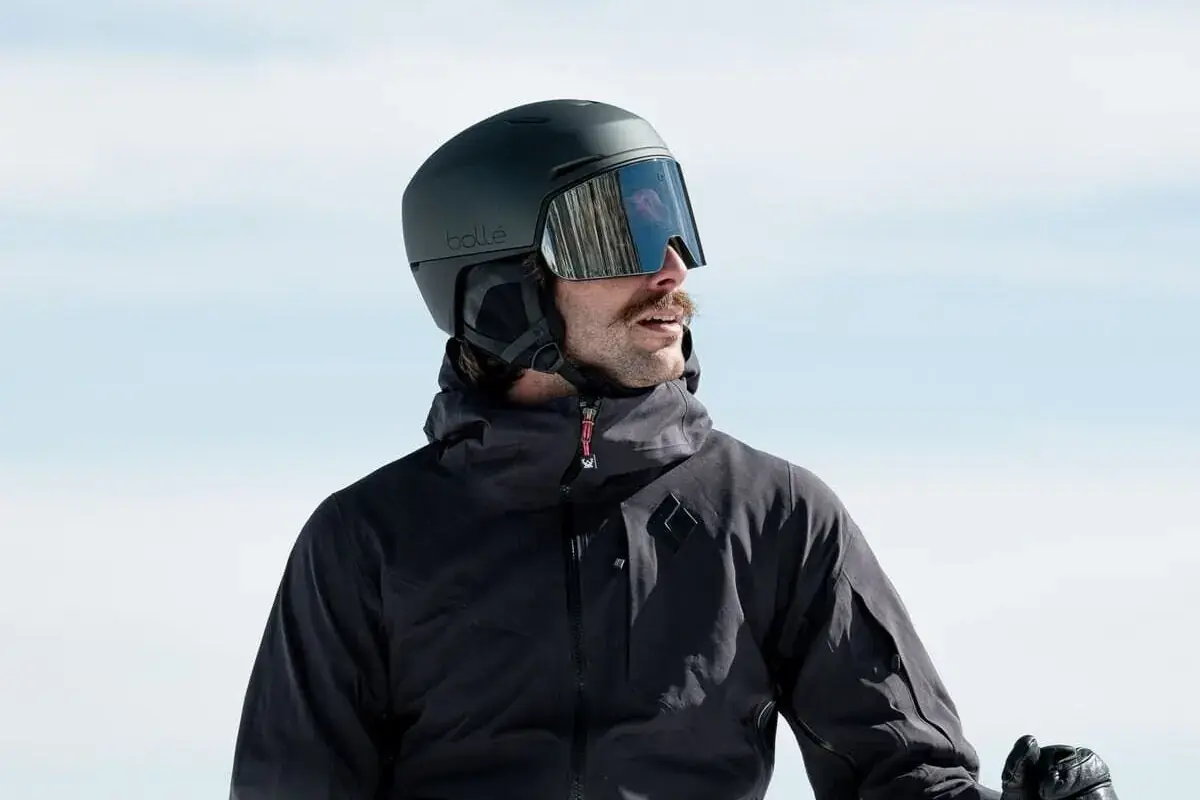
Founded in Oyonnax in France's Jura mountains in 1888, Bollé pioneered technical nylon frames before moving into snow goggles and helmets. Here is how Phantom and Volt lenses compare, how X-Fusion, Ryft, Atmos and Nevada differ and how to get sizing and care right.
The essentials at a glance
- 01
Séraphin Bollé founded the workshop in Oyonnax in France's Jura mountains in 1888. After early work with celluloid and injection-moulded nylon, Bollé launched its first ski goggles in 1960 and its first ski helmet collection in 2007.
- 02
Bollé splits goggle optics by task: Phantom and Phantom+ cast from NXT® polymer adapt automatically across Cat. 1 to Cat. 3, while Volt and Volt+ boost colour perception by up to 30 percent according to Bollé.
- 03
Across helmets, Atmos focuses on low-weight In-Mold builds, Ryft pairs hybrid shells with active freeride ventilation, Medalist serves alpine racing, and X-Fusion, V-Ryft and Might Visor integrate panoramic visors over prescription glasses.
- 04
The Pure suffix (as on X-Fusion Pure, Ryft Pure or Atmos Pure) marks the streamlined core model of a helmet line, sharing the same EN 1077 safety certification at a lower entry point without optional extras.
Midday March sun glares off a high glacier bowl, then twenty minutes later flat cloud swallows the shaded lower run. Ride too dark a mirror tint and wind-scoured ruts disappear into whiteout; squeeze prescription glasses under a narrow goggle frame and trapped breath fogs both lenses on the first chairlift. Managing light, airflow and impact protection as one connected unit is the engineering focus of Bollé.
Browse the winter range and you meet model families such as Nevada, Nevada NEO, Torus M, Ryft, Atmos, Keystone, Medalist and X-Fusion alongside suffixes like Mips, Pure, Phantom+ and OTG. Behind the shorthand sits a logical structure covering piste cruising, freeride lines, ski touring and gate training.
Bollé started in Oyonnax in the Ain department of eastern France, tucked into the Jura hills near Geneva. Known across France as Plastics Valley, the town became a cradle of polymer engineering. In 1888, Séraphin Bollé opened a small workshop turning boxwood and horn combs before becoming one of the earliest French makers to adopt newly invented celluloid.
Following the Second World War, Bollé pushed nylon moulding to industrial safety tolerances, laying the groundwork for modern sport optics and head protection:
- 1936 and 1956: Launch of the first Bollé sunglasses in 1936, followed in 1956 by Georges Bollé's famous nylon cat-eye sunglasses.
- 1950: Entry into industrial protective eyewear, establishing Bollé Safety, whose anti-fog and anti-scratch coatings still feed directly into today's alpine goggle lenses.
- 1960: First Bollé ski goggles released for winter sports.
- 1986 to 2015: Cycling breakthrough with the wide-shield Chronoshield sunglasses (1986), expansion into winter head protection with the first Bollé ski helmet line in 2007, and dedicated road, MTB and urban cycling helmets from 2015.
Today the brand operates under French parent group Bollé Brands, which holds B Corporation certification according to the official B Lab directory.
Before picking a frame shape, check the lens filter category. Under European ski goggle standard EN 174, every snow lens is graded by VLT (Visible Light Transmission): Cat. 0 (80 to 100% VLT for night skiing), Cat. 1 (43 to 80% for fog and snowfall), Cat. 2 (18 to 43% for mixed cloud), Cat. 3 (8 to 18% for bright alpine sun) and Cat. 4 (3 to 8% reserved for high-altitude glacier eyewear).
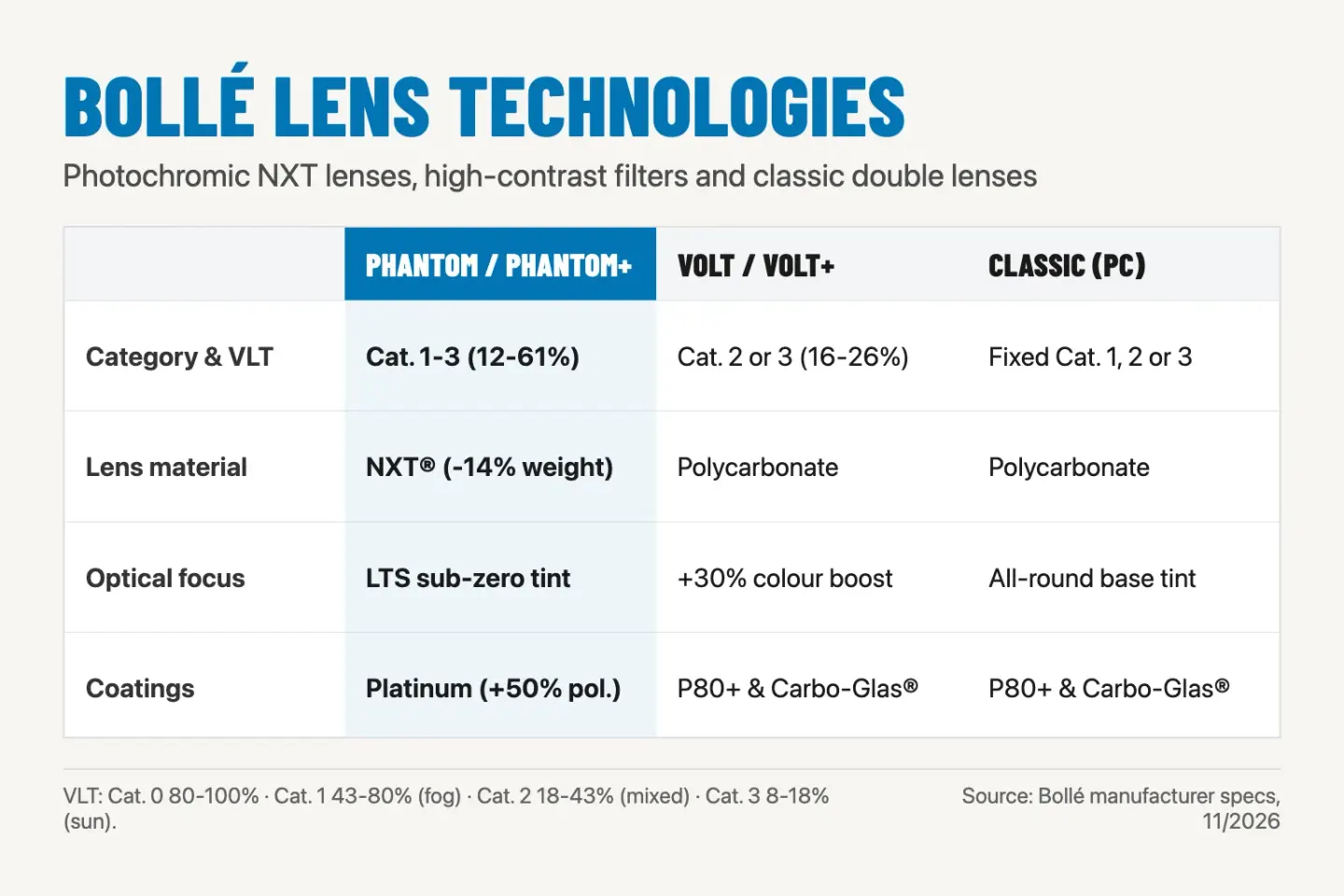
Within that scale, Bollé builds three distinct lens tiers:
- Phantom and Phantom+ (photochromic NXT®): Cast from NXT® polymer originally developed for military helicopter windshields, these lenses are 14 percent lighter than polycarbonate according to Bollé while offering crisp optical clarity and high impact resistance. Because the photochromic filter is cast directly into the monomer rather than sprayed on as a thin film, the tint shifts smoothly from Cat. 1 to Cat. 3 (such as 61% down to 15% VLT) without peeling. LTS (Low Temperature Sensitivity) keeps the tint responsive even in sub-zero mountain air. Bollé pairs this with its industrial Platinum coating, rated 40 percent more scratch-resistant than standard coatings according to company figures. Phantom+ adds a 50 percent semi-polarised film that cuts harsh glare while leaving enough reflection to spot slick ice patches.
- Volt and Volt+ (high-contrast tint): Rather than changing darkness, Volt locks into a fixed category (typically Cat. 2 or Cat. 3) and sharpens terrain relief. Evaluating over 20 million colour combinations computationally, Bollé formulated a patented filter that increases colour perception by up to 30 percent according to the manufacturer while preserving a natural white point on snow. Volt+ adds full polarisation.
- Classic polycarbonate double lenses (SLF / PC): Proven fixed tints such as Sunrise, Vermillon Gun (Cat. 2, 22% VLT) and Sunshine (Cat. 3). A sealed thermal air pocket separates the outer and inner lenses, backed by Carbo-Glas® outer scratch protection, an inner P80+ anti-fog layer and Flow-Tech® frame venting.
Lens curvature shapes how wide your peripheral view feels. Cylindrical lenses curve horizontally while staying flat vertically for a clean freeride profile. Toric lenses combine tighter horizontal curvature with gentler vertical curvature to widen peripheral vision and reduce optical distortion at the edges.
- Nevada family (cylindrical & frameless): Bollé's flagship cylindrical goggle, worn on the World Cup circuit by athletes including Alexis Pinturault. The standard Bollé Nevada (130 g, Medium/Large TPU frame) fits medium to wider faces, while the Bollé Nevada Small scales down the exact same frameless silhouette for narrower faces. For instant lens swaps when clouds roll in, the Bollé Nevada NEO ships with two magnetic lenses (Cat. 1 and Cat. 3) locked in place by Bollé's mechanical EyeLatch clasp. Young skiers get the matching Bollé Nevada JR.
- Torus M (toric wide-field optics): Weighing 120 g, the Bollé Torus M pairs a wide-angle toric lens with photochromic Cat. 1 to Cat. 3 coverage (10 to 45% VLT), letting you ski from morning cloud to afternoon sun on one lens.
- All-round, women's and kids' goggles: Clean all-mountain frames with triple-layer face foam include the Bollé Blackridge and Bollé Cerro, alongside the wide-fit Bollé Mammoth. Slimmer facial proportions are served by the Bollé Blanca and Bollé Sierra, while children's sizes span Bollé Inuk, Bollé Royal, Bollé Rocket and Bollé Rocket Plus.
- OTG goggles for spectacle wearers: Over The Glasses frames carve side channels into the face foam and deepen the chamber so prescription frames sit without temple pressure. Dedicated choices include the Bollé X7 OTG and Bollé Bedrock Plus (120 g), alongside OTG-friendly Torus M and Nevada NEO frames.
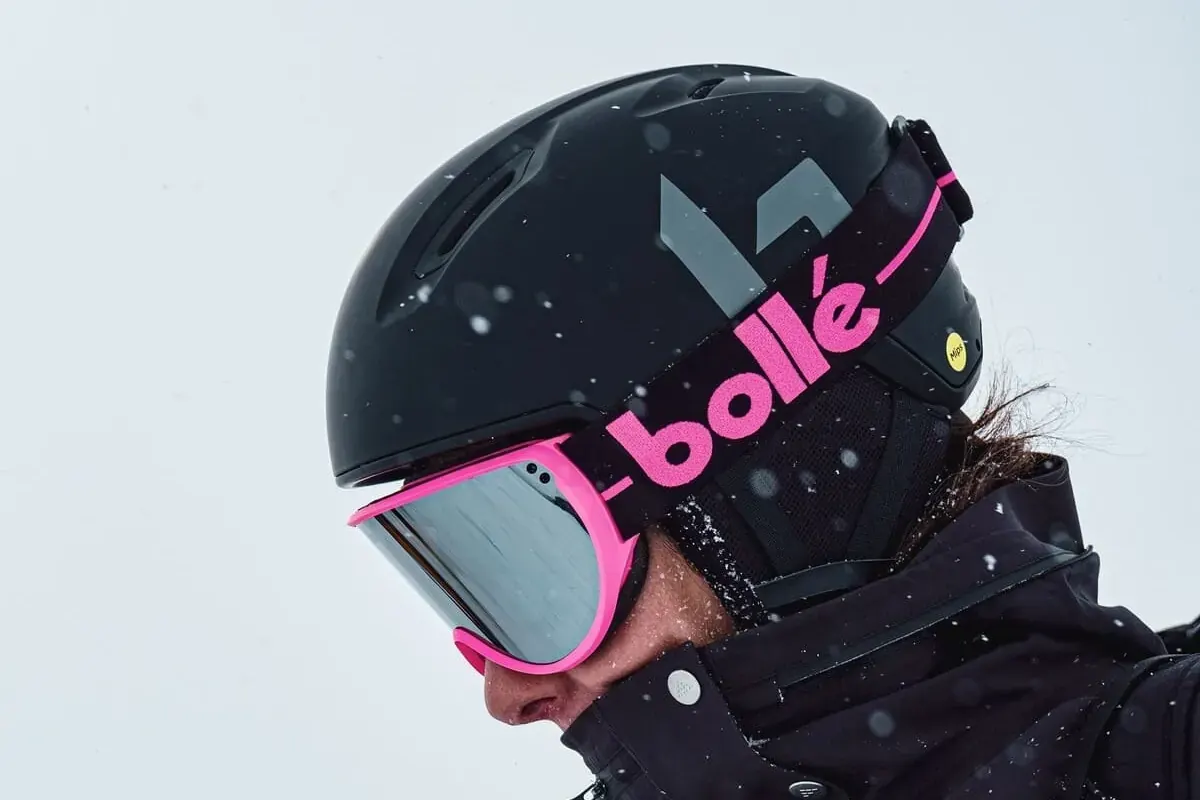
Because Bollé engineers helmets and goggles under one roof, brow vents align directly with Flow-Tech goggle channels. Inside the shell, two impact technologies stand out: AViD Progressive EPS combines high-density foam for heavy hits with lower-density zones that absorb lighter impacts and open deep internal airflow channels while meeting EN 1077 standards. Select models add a MIPS® low-friction liner to reduce rotational motion during angled impacts. At the nape, a rubberised Click-to-Fit™ dial (or BOA® dial on flagship models) lets you fine-tune tension without pulling off your ski gloves.
One helpful naming rule: whenever a Bollé helmet carries the Pure label, it represents the streamlined core specification of that platform. Shell geometry, airflow layout and EN 1077 protection stay identical, while add-ons such as magnetic Fidlock buckles, MIPS liners or upgraded visors are omitted to keep weight and price down.
Bollé ski and visor helmet families compared
| Feature | Atmos series | Ryft seriesVisor favourite | X-Fusion series (visor) | Medalist series (race) |
|---|---|---|---|---|
Shell construction | Lightweight In-Mold shell | Hybrid (ABS top, In-Mold sides) | In-Mold with flush integrated visor | ABS hardshell or full carbon |
Ventilation | 9 passive vents + AViD channels | Adjustable Active Panel Ventilation | Adjustable top shell slider | Fixed race venting |
Typical weight (size M) | approx. 420–470 g | approx. 545 g (V-Ryft: 590 g) | approx. 520 g (X-Fusion Pure) | Solid race-grade shell |
Core rider profile | Weight-conscious piste & all-mountain skiers | Freeriders & high-output skiers | Spectacle wearers & all-in-one comfort | Gate training, youth & FIS racing |
Classic snow helmets for piste, freeride, touring and racing
Skiers prioritising low weight gravitate toward the Atmos range: the Bollé Atmos Mips pairs an In-Mold polycarbonate shell with nine vents, AViD Progressive EPS and MIPS protection, flanked by the Bollé Atmos, Bollé Atmos Pure and junior Bollé Atmos Youth.
For freeride lines and spring slush, the Ryft family fuses a tough ABS top shell with light In-Mold sidewalls and wide Active Panel Ventilation sliders. Options include the Bollé Ryft Mips (545 g in M, Fidlock magnetic buckle, audio-ready earpads), Bollé Ryft Pure Mips and Bollé Ryft Pure.
Durable hardshell and all-mountain coverage comes from the Bollé Keystone Mips (550 g in M, also listed for ski touring alongside Bollé Keystone and Bollé Keystone Youth), the 490 g women's Bollé Juliet, freestyle hardshells Bollé Mute and Bollé Border, plus the Bollé Ypsos Mips and hybrid Bollé Zenos Mips. Racers get the full-carbon Bollé Medalist Carbon Pro Mips, Bollé Medalist Pure and Bollé Medalist Youth.
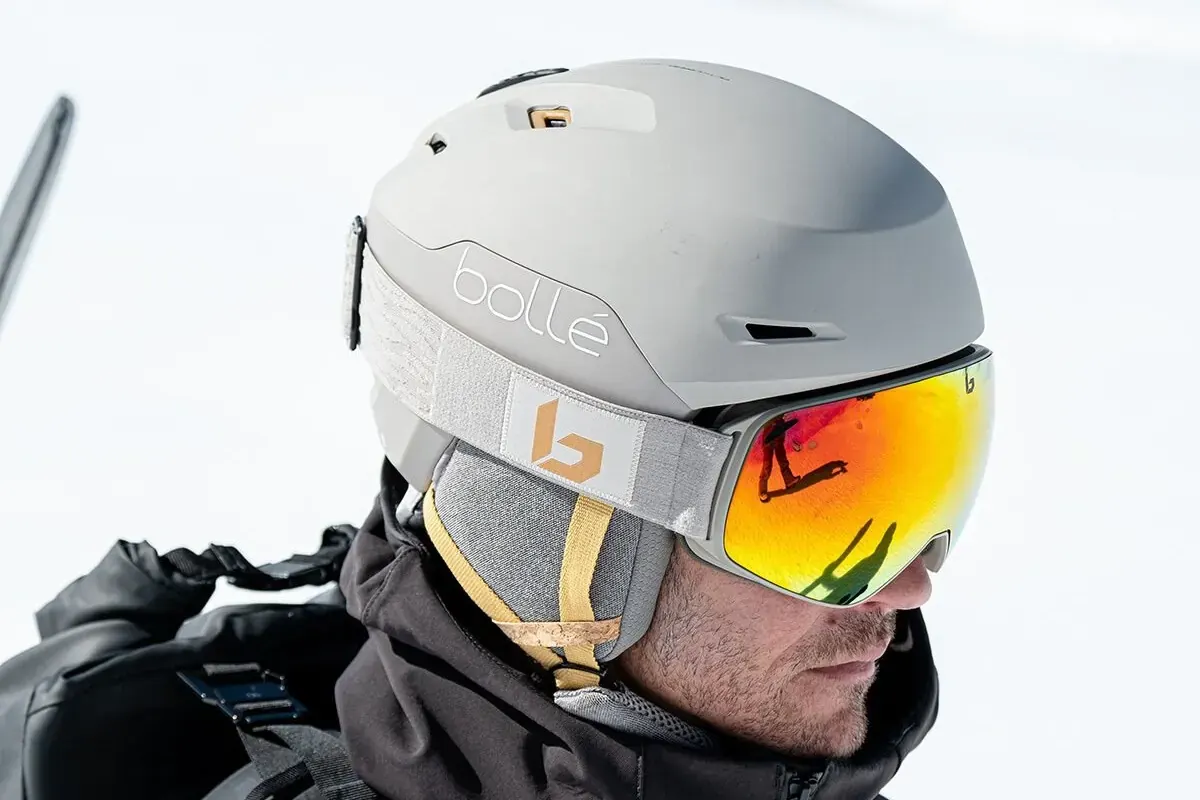
Visor helmets: panoramic vision over prescription eyewear
Visor helmets replace separate goggles with a hinged panoramic shield anchored directly to the shell. For spectacle wearers, that solves two persistent headaches at once: zero foam pressure pinching optical frames against your nose bridge, and generous internal air volume that resists fogging when you stop on the slope.
Leading the category is the X-Fusion platform, whose visor sits completely flush with the shell rim: choose between the Bollé X-fusion Mips with photochromic shield and magnetic buckle, the Bollé X-fusion and the 520 g Bollé X-fusion Pure. Skiers wanting Ryft or Atmos ventilation in a visor format can pick the Bollé V-ryft Pure (590 g, photochromic visor, six adjustable vents) or the lighter In-Mold Bollé V-atmos, while the ABS Bollé Might Visor and Bollé V-line cover straightforward piste skiing.
Six popular Bollé picks from our range
From flush X-Fusion and V-Ryft visor helmets to Ryft and Atmos MIPS helmets plus Nevada and Torus M goggles
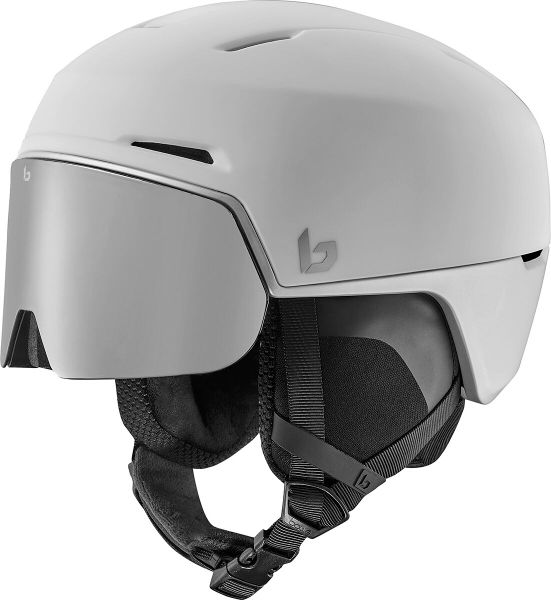 BolléX-fusion PureLightweight In-Mold visor helmet (520 g in M) with flush visor integration and room for optical glasses.171.55€View product →
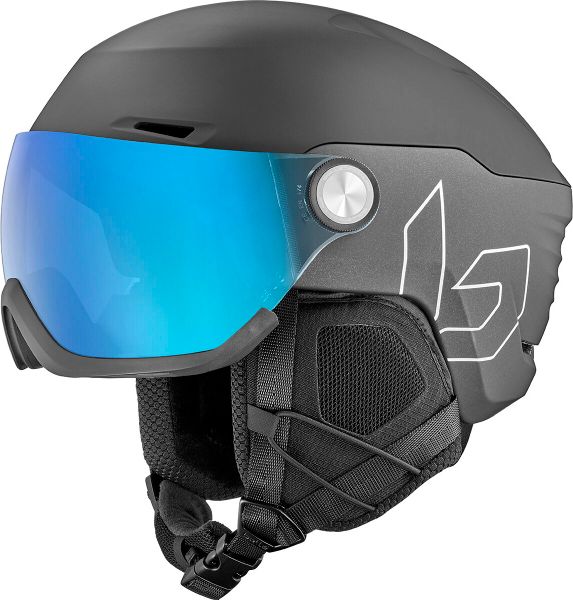 BolléV-ryft PureHybrid visor helmet (590 g) pairing a photochromic shield with six adjustable ventilation ports.178.55€View product →
 BolléRyft MipsHigh-airflow freeride helmet (545 g in M) with MIPS protection and Fidlock magnetic chin buckle.269.90€View product →
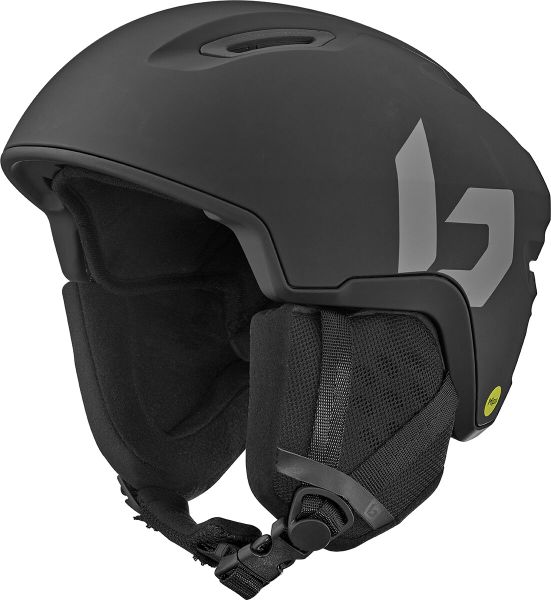 BolléAtmos MipsLightweight In-Mold ski helmet featuring AViD Progressive EPS, MIPS liner and Click-to-Fit dial.104.85€View product →
 BolléNevadaFrameless cylindrical ski goggles (130 g, Medium/Large) with Flow-Tech venting and anti-fog double lens.69.75€View product →
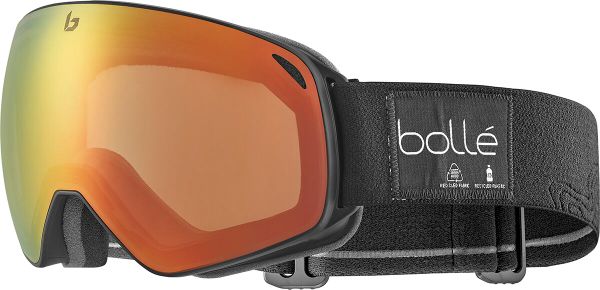 BolléTorus MPhotochromic toric ski goggles (120 g, Cat. 1 to 3) built for wide, distortion-free peripheral vision.147.35€View product →
Every setup carries real boundaries on the mountain. Integrated visor helmets such as X-Fusion or V-Ryft shine on groomed runs, frequent chairlift laps and over prescription glasses. In horizontal high-alpine spindrift or deep over-the-shoulder powder tumbles, however, the full-perimeter triple-layer foam of a classic Ryft Mips plus Nevada goggle combo seals more tightly against cheekbones than a pivoting visor lip.
Polarisation deserves similar nuance. Full Volt+ polarisation cuts blinding glare on wet spring snow, yet on hard-packed shaded pistes it can mute the telltale sheen that warns you of sheer ice. For mixed resort snow, unpolarised Volt, standard Phantom or 50-percent semi-polarised Phantom+ lenses keep surface texture easier to read.
Matching the right Bollé setup to how you ski
- 1
If you wear prescription glasses and mainly ski groomed pistes
pick an X-Fusion Pure, X-Fusion Mips or V-Ryft Pure visor helmet for pressure-free airflow.
- 2
If you ski storm days and deep off-piste snow
pair a classic helmet (Ryft Mips, Atmos Mips) with sealed frameless goggles (Nevada, Torus M).
- 3
If light shifts constantly and you dislike carrying spare lenses
choose a photochromic Cat. 1–3 lens (Torus M, Phantom) or magnetic Nevada NEO twin-lens goggles.
- 4
If your head measurement sits right on a size boundary
step up to the larger shell and dial in tension with Click-to-Fit so a thin liner beanie still fits underneath on freezing days.
Right for you if …
Resort skiers, freeriders and spectacle wearers who want adaptive or high-contrast optics paired with gap-free helmet integration
Probably not for you if …
Riders expecting an open visor lip to seal out waist-deep powder crashes or trying to ski dense fog in a dark Cat. 3 sun lens
A helmet only works properly when it stays steady on your head before fastening the chinstrap, without pinching your temples. Wrap a soft tape measure horizontally around your head roughly one centimetre above your eyebrows and ears. Adult Bollé snow helmets follow three standard shell brackets:
- Size S: 52 to 55 cm head circumference
- Size M: 55 to 59 cm head circumference
- Size L: 59 to 62 cm head circumference
Youth helmets such as Atmos Youth and Keystone Youth typically span 49 to 52 cm (XS/S) and 52 to 55 cm (S/M). Goggles scale by face width: XS for children (Inuk, Rocket, Royal), S for narrow faces, women and teens (Nevada Small, Blanca, Sierra), M for medium faces (Torus M, Bedrock Plus) and M/L or L for medium-to-wide faces (Nevada, Nevada NEO, Mammoth, X7 OTG).
Four care habits protect both coatings and impact foam season after season:
- Never rub a wet inner lens: Hydrophilic P80+ and Platinum anti-fog coatings absorb moisture and soften when damp. Shake loose snow off, let the goggles air-dry completely at room temperature and only dab gently with the microfibre pouch once dry.
- Avoid heat and solvents: Keep helmets and goggles off radiators and sunny car dashboards. Wipe helmet shells only with lukewarm water and mild soap, avoiding alcohol or glass cleaners that attack polycarbonate and EPS foam.
- Wash liners gently: Removable comfort linings and earpads on Bollé helmets can be hand-washed or machine-washed on a gentle cycle up to 30 °C, then air-dried completely before refitting.
- Replace after impacts: Any helmet involved in a hard crash must be replaced immediately even if the outer shell looks unmarked, as EPS foam crushes permanently when absorbing impact energy. Under normal use, replace snow helmets every three to five winter seasons.
Explore the full Bollé winter range
From X-Fusion and V-Ryft visor helmets to Atmos and Ryft MIPS helmets plus Nevada, Torus and junior ski goggles.
Shop all Bollé productsFrequently asked questions
What is the difference between Bollé Phantom and Bollé Volt goggle lenses?
Phantom and Phantom+ lenses are cast from lightweight NXT® polymer with a molecular photochromic filter that automatically shifts from Cat. 1 (cloud and snow) to Cat. 3 (bright sun), backed by sub-zero LTS responsiveness. Volt and Volt+ lenses keep a fixed filter category while using a patented high-contrast tint that boosts colour perception by up to 30 percent according to Bollé without distorting the natural white tone of snow.
What does the "Pure" suffix mean on Bollé helmets like X-Fusion Pure or Ryft Pure?
"Pure" designates the streamlined core version of a Bollé helmet family. You get the same shell architecture, venting layout and EN 1077 impact certification as higher-tier siblings, without optional upgrades such as MIPS liners, Fidlock magnetic buckles or premium lens packages.
Which Bollé models work best over prescription glasses?
Visor helmets such as the X-Fusion Mips, X-Fusion Pure, V-Ryft Pure, V-Atmos and Might Visor offer the easiest fit because optical frames sit freely behind the pivoting shield with ample airflow. Prefer traditional goggles? Pick OTG-compatible frames with temple cutouts and deeper chambers such as the X7 OTG, Bedrock Plus, Torus M or Nevada NEO.
Should I choose Bollé Nevada or Nevada Small?
Both share the same frameless cylindrical look, anti-fog double lens and seamless Bollé helmet fit. The standard Nevada (Medium/Large) suits medium to wider faces, while the Nevada Small scales the frame down proportionally so it seals cleanly on narrower faces and teens without pinching the nose.
Why do ski goggles still fog up sometimes despite anti-fog coatings?
Common culprits include snow blocking top frame vents, tucking a balaclava under the bottom foam where warm breath shoots straight inside, or resting goggles on a sweaty forehead during lift rides. Wiping a damp inner lens with gloves or tissues also strips the moisture-absorbing anti-fog treatment permanently.
SportFits editorial team
Marketing & Sales Manager at SportFitsNiklas is Marketing & Sales Manager at SportFits and studied applied sports science in Regensburg. In the magazine he writes about training science, fitness and longevity, putting trends into scientific context instead of simply celebrating them. He also looks at what really matters in outdoor gear: honest facts instead of empty advertising language.
Author profile →SportFits
outdoors looks good on you