Stories
Dalbello: Cabrio shell design, last widths and ski boot lines explained
In partnership withDalbello
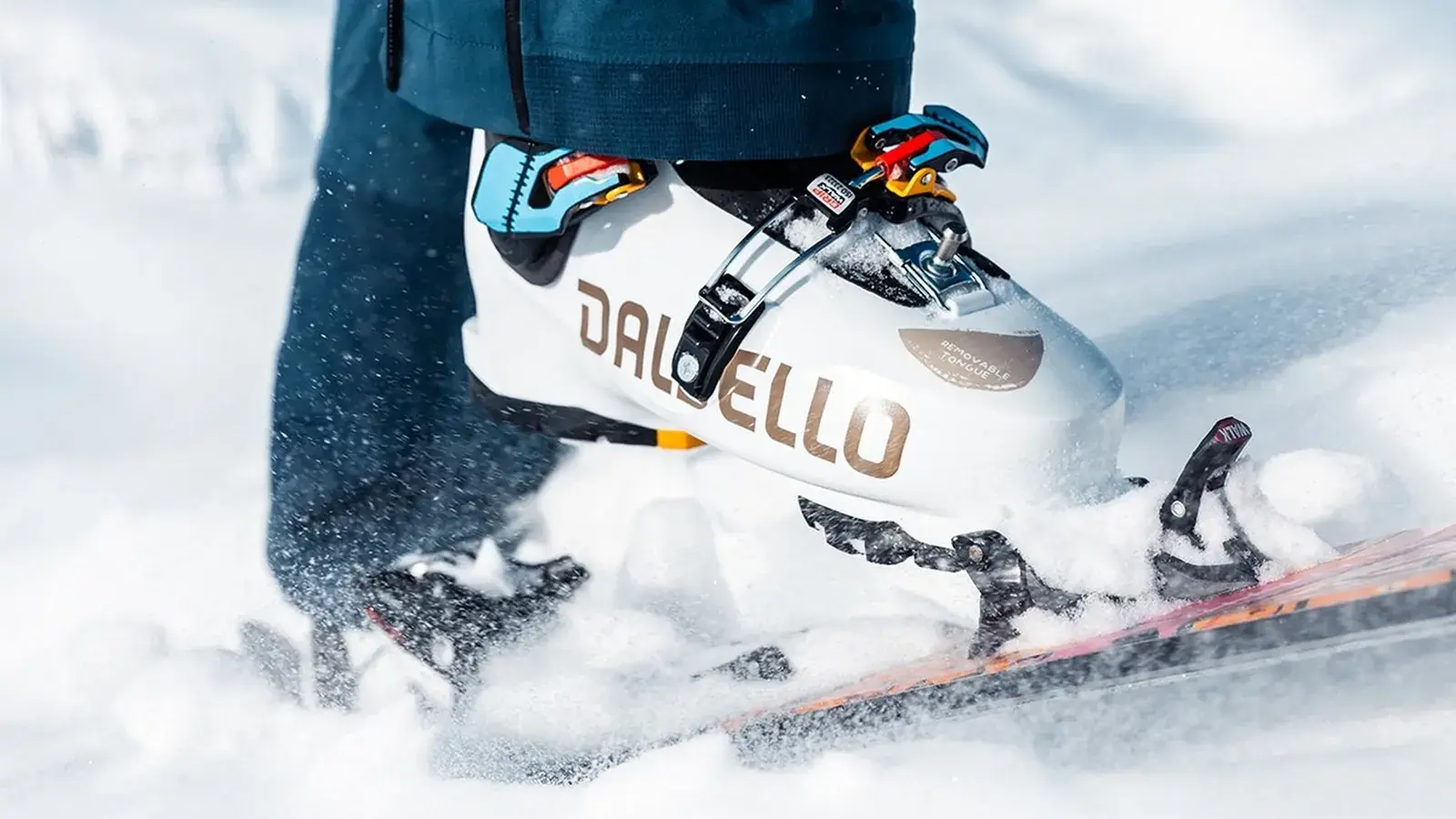
Founded in Asolo in northern Italy in 1974, Dalbello builds ski boots across three distinct shell architectures. Here is how Cabrio, Overlap and Bonded Shell compare, which last width from DRS and Veloce Space to Quantum fits your foot, and how Mondopoint sizing works.
The essentials at a glance
- 01
Master shoemaker Alessandro Dal Bello and his wife Giovanna founded the company in 1974 in Casella d'Asolo at the foot of the Dolomites after honing their ski-boot craft in Switzerland during the early 1960s.
- 02
Dalbello engineers three separate shell architectures: its signature 3-piece Cabrio design with an external kinetic tongue (Cabrio, Il Moro, CX Junior), the 2-piece Overlap shell for immediate edge power (DRS, Veloce) and the longitudinally Bonded Shell for backcountry touring (Quantum).
- 03
Adult last widths at reference size Mondopoint 26.5 span every foot volume: 92 mm on FIS-ready DRS WC boots, 98 mm (DRS), 99 mm (Cabrio LV, Quantum EVO), 100 to 101 mm (Veloce MV, Veloce Space, Cabrio MV), 102 mm (Quantum Space) and 104 mm on Veloce Max.
- 04
Closures and outsoles divide cleanly by discipline: Veloce Space Dual pairs two BOA® dials with GripWalk (ISO 23223) soles, DRS sticks to flat ISO 5355 alpine race soles, and Quantum mounts rockered Vibram® touring outsoles for pin bindings.
Three millimetres of excess width across the forefoot are enough to let your heel lift on a hard traverse. Conversely, a shell that pinches your navicular bone on the morning gondola ride ruins your stance before the second run. That narrow geometry of forefoot volume, instep height and forward flex curve is what Dalbello has refined in Italy's Veneto foothills for more than five decades.
Look across the current line-up and you see markedly different silhouettes side by side: dense four-buckle Race-PU overlap boots, three-piece freeride shells with ribbed Pebax tongues, dual-dial wire-closed piste boots and featherweight carbon-composite touring models. Behind names like DRS, Veloce, Cabrio, Il Moro, Quantum and CX sits a logical modular matrix.
Dalbello's story started across the border in Switzerland. During the early 1960s, Alessandro and Giovanna Dal Bello worked as ski-boot artisans at the respected Henke boot factory, learning alpine last design and upper construction firsthand. When the couple returned to northern Italy with their young family, they settled near Asolo in the province of Treviso close to the Montebelluna footwear district and stitched leather ski-boot uppers for Henke under contract.
Contract stitching left little room for independent engineering. In 1974, Alessandro and Giovanna launched their own factory in Casella d'Asolo and sold the first Dalbello-branded ski boots in Austria. Their timing matched alpine skiing's biggest material shift: injection-moulded plastics were replacing stitched leather, allowing nimble Italian workshops to iterate hinge positions and buckle geometry rapidly.
By the 1980s Dalbello stepped onto international race courses, working with American speed skier Steve McKinney, who had broken the 200 km/h barrier on skis in 1982. In 1997 the Carvex series addressed shaped carving skis with stronger lateral support. Shortly after the turn of the millennium, freeski pioneer Glen Plake teamed up with Asolo's R&D engineers to launch the Rider Development Program (RDP) alongside athletes such as Tanner Hall, Nick Goepper and Kevin Rolland. By 2014 the factory had built 13 million pairs of ski boots; today Dalbello forms part of the Elevate Outdoor Collective alongside Völkl, Marker and K2 while keeping its design and bootmaking anchored in Asolo.
Rather than forcing every skier into one shell layout, Dalbello builds three distinct structural platforms. Choosing between them matters just as much as picking your flex index.
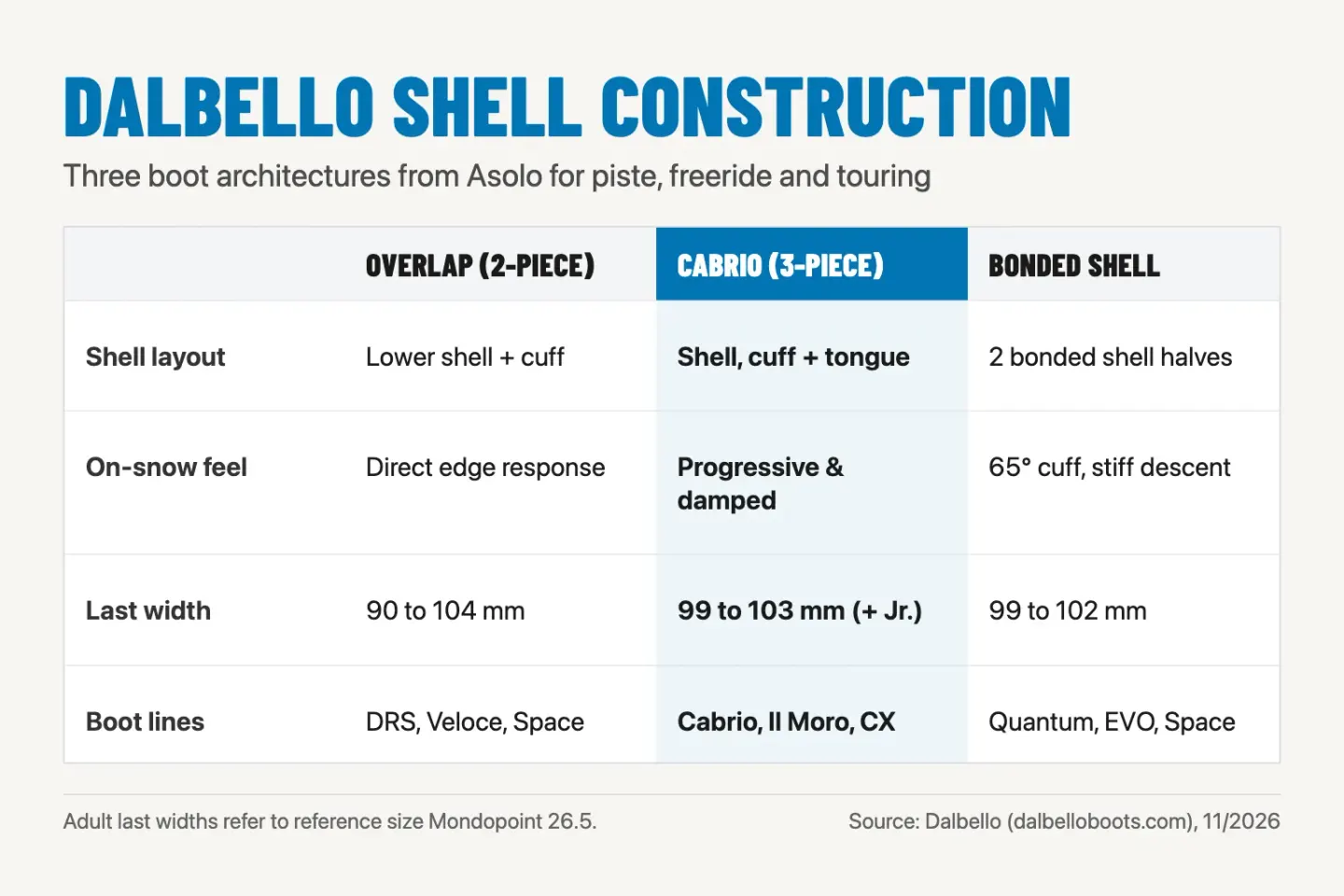
Cabrio design (3-piece): Shell, cuff and kinetic tongue
Dalbello's signature platform separates the boot into three parts: a rigid lower shell with tall lateral walls, an articulated upper cuff and an external kinetic response tongue (moulded from Pebax Rnew or polyurethane with engineered flex ribs). Because the lower shell walls do not overlap across the instep, forward flex comes almost entirely from the ribbed tongue.
On snow, that layout delivers three tangible traits. Resistance builds smoothly and progressively without bottoming out harshly on flat landings or tracked-out chop. A 45-degree instep buckle (Dynalock) pulls your heel straight back into the pocket without crushing your arch. And when you unbuckle in a cold car park, the hinged tongue flips right forward out of the way for effortless entry.
Overlap construction (2-piece): Immediate edge transfer
On firm corduroy, icy pitches and race gates, Dalbello turns to traditional 2-piece Overlap construction. Lower shell and upper cuff wrap over one another across the forefoot and shin, locked together by four micro-adjustable buckles or tensioned steel cables. Press your shin forward and the closed cuff transfers energy straight into the ski edge with crisp rebound out of each turn. Stepping in takes a firmer pull on cold mornings than a Cabrio shell, though bi-injected softer instep zones on Veloce models ease entry noticeably.
Bonded Shell: Welded shell halves built for vertical gain
Backcountry touring demands wide ankle articulation going up and torsional rigidity coming down. In the Quantum family, Dalbello injection-moulds separate left and right shell halves from polyamide composite (reinforced with carbon fibre on Quantum EVO) and welds them longitudinally onto a continuous sole plate without traditional rivets. Above sits the two-part EVO Dual Link cuff, opening up 65 degrees of cuff rotation on the skin track before locking down solidly via a Hike & Ride lever and memory Velcro strap at the summit.
Within those three shell families, Dalbello scales last width (always stated at reference size Mondopoint 26.5) and flex stiffness. Numbers around 65 to 85 suit lighter or relaxed skiers, 95 to 110 hit the athletic all-mountain sweet spot, and 120 to 140 reward strong, technical skiers.
Veloce, Veloce Space Dual BOA® and Veloce Max: Piste & all-mountain
Built on two-piece overlap shells, the Veloce line covers groomed runs and resort all-mountain skiing across three clear forefoot widths:
- Veloce MV (99 to 100 mm last): Athletic medium-volume fit using bi-injected shells (softer across the top for entry, stiffer underneath for edge hold) and Contour 5 shaping, which pre-forms relief pockets at the navicular, both ankles and sixth toe. Popular picks include the Dalbello Veloce 120 MV, the stiffer Dalbello Veloce 130 MV and the women's Dalbello Veloce 95 MV W with a tailored cuff height.
- Veloce Space & Space Dual (101 mm adaptive fit): Adds a touch more forefoot room. Alongside four-buckle options like the Dalbello Veloce Space 100 and women's Dalbello Veloce Space 105 W, the Dalbello Veloce Space 120 Dual and Dalbello Veloce Space 130 Dual integrate the Dual Dial BOA® Fit System on both lower shell and upper cuff, paired with AUTOFIT memory-foam tongues and pre-shaped Ankle Sense malleolus zones.
- Veloce Max (104 mm last): Generous wide-fit overlap boots with easy step-in cuffs for broader feet and relaxed resort days, led by the Dalbello Veloce MAX 75, Dalbello Veloce MAX GripWalk 90 and women's Dalbello Veloce MAX 65 W.
Cabrio LV, Cabrio MV, Cabrio Free and Il Moro: Freeride & freestyle
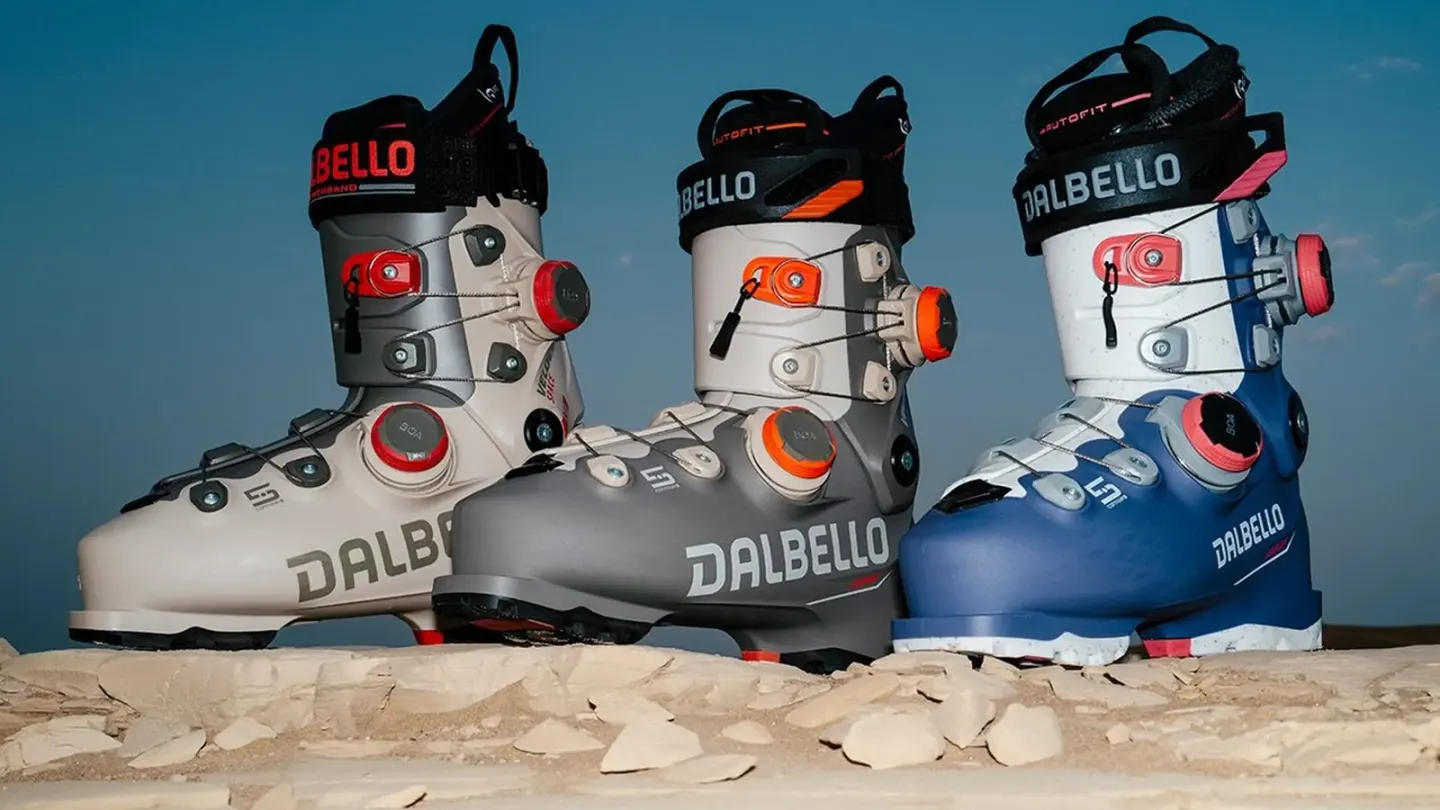
Step off groomed runs or into the terrain park and Dalbello's three-piece Cabrio design takes over. LV (Low Volume) denotes a 99 mm last on models like the Dalbello Cabrio LV 120 3DWRAP, while MV (Medium Volume) widens to 101 mm on the Dalbello Cabrio MV 120 3DWRAP and women's Dalbello Cabrio MV 95 W 3DWRAP. Inside sits a three-layer 3DWrap liner engineered for brisk energy transfer; according to Dalbello, Cabrio LV 3DWrap liners are completely PVC-free and use PuRE (Polyurethane Recycled Enforcement) outer layers made from recycled polyurethane and recycled textiles. Freetourers who climb on skins add a walk mode and tech inserts in boots such as the Dalbello Cabrio LV Free 130 Lite IF.
Park and pipe riders get the Il Moro collection, pairing shock-absorbing bootboards with Dalbello's upright Center Balanced Stance: the Dalbello IL Moro Pro 3DWRAP locks in narrow-to-medium feet (99 mm), whereas the Dalbello IL Moro Jakk IF opens up a 103 mm last and forgiving 80 flex for progressing freestylers.
Quantum: Backcountry ski touring
When long climbs define your winter, Quantum trims grammes aggressively. Weighing roughly 1,050 g per boot, the Dalbello Quantum EVO mates a carbon-reinforced polyamide Bonded Shell (99 mm last) with 65 degrees of cuff travel and a dual-density Vibram® rocker sole. Downhill-focused tourers look to the Dalbello Quantum Free, while the rivet-free Dalbello Quantum Space Pro expands forefoot room to 102 mm for wide-footed tourers; according to Dalbello, its liner outer layer uses 100 percent recycled material.
DRS race boots plus CX and DRS Junior models
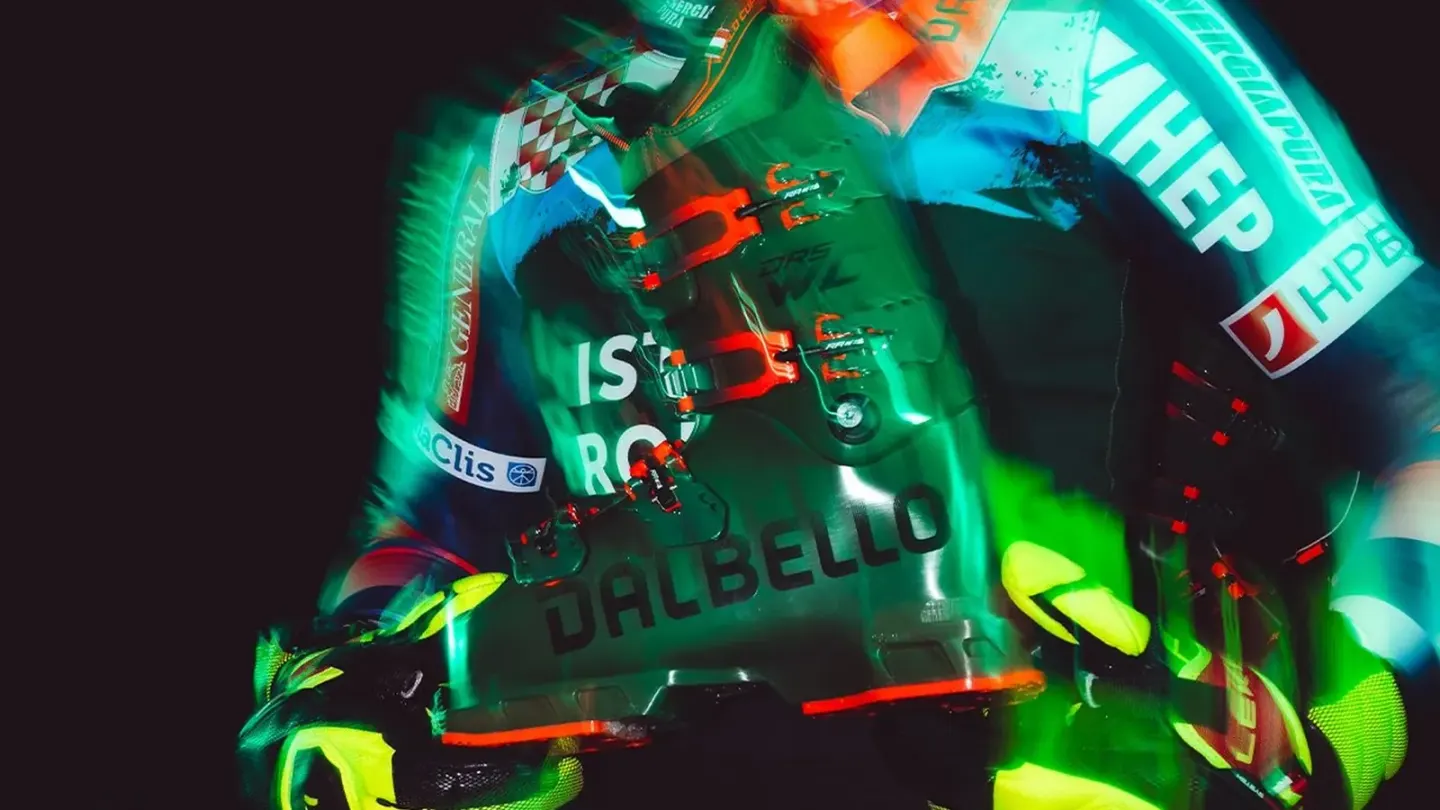
Carvers chasing race-room precision land in the DRS (Dalbello Racing System) family. While the FIS-compliant Dalbello DRS WC S hugs the foot with a 92 mm World Cup last and grindable sole lifters, the Dalbello DRS 130 and Dalbello DRS 110 translate that dense Race-PU overlap feel onto an athletic 98 mm piste last.
For young skiers, Dalbello scales buckle count and flex alongside foot growth: starting from the single-buckle CX 1.0 (flex 20), kids progress to the two-buckle Dalbello CX 2.0 Cabrio GripWalk JR (flex 25) and three-buckle CX 3.0, all equipped with easy-entry Cabrio tongues and GripWalk Junior soles. Junior club racers step into the four-buckle Dalbello DRS 60 JR built on a 90 mm junior race last.
Five core Dalbello boot lines by last width, flex and sole
| Feature | DRS / DRS WCAll-rounder | Veloce MV & Space | Veloce Max | Cabrio LV / MV | Quantum EVO & Space |
|---|---|---|---|---|---|
Shell design | 2-piece Overlap | 2-piece Overlap | 2-piece Overlap | 3-piece Cabrio | 2-piece Bonded Shell |
Last width (MP 26.5) | 98 mm (WC: 92 mm) | 99–100 mm / Space: 101 mm | 104 mm | LV: 99 mm / MV: 101 mm | EVO: 99 mm / Space: 102 mm |
Typical flex range | 75 to 140 (+ WC) | 75 W to 130 | 65 W to 90 | 75 W to 130 | Stiff touring support |
Closure system | 4 race buckles + strap | 4 buckles or Dual BOA® | 4 buckles + 40 mm strap | 3 buckles (45° instep) | Quick lace + Hike/Ride |
Factory outsole | Alpine ISO 5355 | GripWalk ISO 23223 | Alpine / GripWalk | GripWalk ISO 23223 | Vibram® Rocker (pin) |
Six core Dalbello boots from our range
From Dual BOA all-mountain and 3-piece Cabrio freeride boots to touring and race shells
 DalbelloVeloce Space 120 DualAll-mountain ski boot with 101 mm adaptive last, Dual Dial BOA closure and pre-mounted GripWalk soles.487.45€View product →
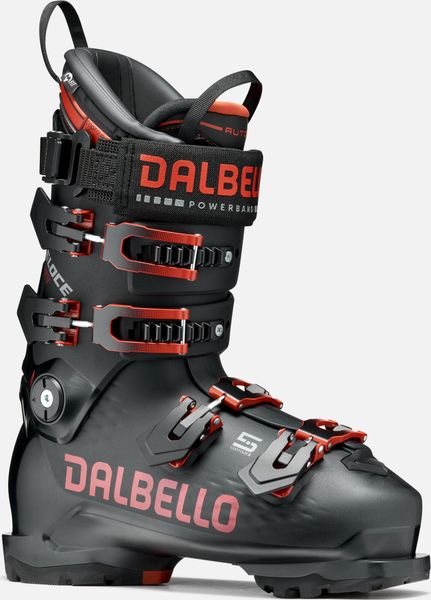 DalbelloVeloce 120 MVAthletic four-buckle overlap boot (100 mm last) featuring Contour 5 shaping and MyFit customisation.450.25€View product →
 DalbelloVeloce MAX 75Wide-fit piste boot with a roomy 104 mm last and forgiving 75 flex for relaxed resort days.141.95€View product →
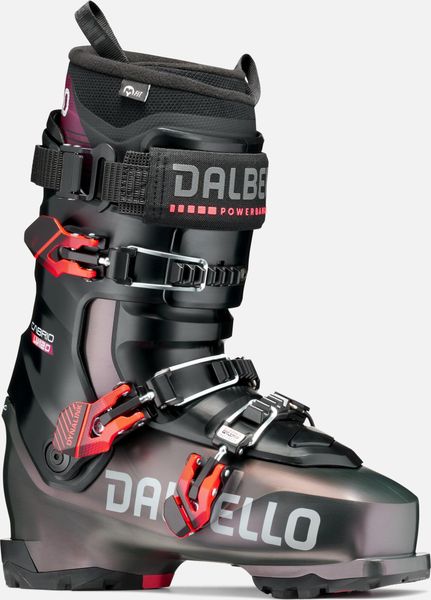 DalbelloCabrio LV 120 3DWRAPThree-piece freeride boot (99 mm last) with Pebax tongue, 45-degree instep buckle and 3DWrap liner.649.90€View product →
 DalbelloQuantum EVOLightweight carbon-polyamide touring boot (approx. 1,050 g) with 65-degree cuff rotation and Vibram sole.506.15€View product →
 DalbelloDRS 130World Cup-derived Race-PU piste boot combining a 98 mm last, DB Comp liner and flat ISO 5355 sole.649.90€View product →
Before ordering a pair of ski boots online, check three practical constraints. First comes outsole and binding compatibility. Most current Veloce, Veloce Space, Cabrio, Il Moro and CX Junior boots ship with rockered GripWalk (ISO 23223) soles. They click straight into any GripWalk-marked alpine binding, MN/MNC multi-norm binding or ISO 13992 touring binding without height adjustment, yet they are not compatible with older flat alpine-only bindings (ISO 9462), where the curved toe pad alters release values. Likewise, Quantum touring boots use lugged Vibram® touring soles built solely for pin/tech or certified hybrid bindings, never standard alpine bindings.
Second, understand the distinct feel of a Cabrio tongue. Skiers coming straight off rigid four-buckle overlap race shells like the DRS sometimes find a Cabrio boot surprisingly supple during the first centimetre of carpet flexing indoors. Its advantage shows up outdoors in variable snow, moguls and landings rather than razor-thin slalom arcs on injected ice. Finally, resist buying an overly soft wide boot such as the Veloce Max 75 if you are a heavier or fast skier: collapsing through the ankle cuff at speed reduces tail control, making a stiffer Veloce Space 120 (101 mm, heat-expandable via MyFit) the smarter starting point.
Matching the right Dalbello platform to your skiing
- 1
If you carve hard icy pistes and have narrow feet
choose DRS 110 or DRS 130 (98 mm, ISO 5355) instead of a damped Cabrio shell.
- 2
If you have a high instep or suffer from buckle pressure points
look to Veloce Space Dual BOA (101 mm) or a flip-tongue Cabrio boot.
- 3
If your days involve 1,000+ vertical metres on skins
pick Quantum EVO (99 mm) or wide-fit Quantum Space Pro (102 mm) over heavy alpine shells.
- 4
If you have broad feet around 102–104 mm yet ski fast and aggressively
step into a stiffer Veloce Space 120 and heat-mould it rather than overpowering a soft Veloce Max 75.
Right for you if …
Piste carvers, freeriders and ski tourers who want to match shell mechanics and exact millimetre last width to their foot shape
Probably not for you if …
Skiers running older ISO 9462 alpine-only bindings without GripWalk certification (unless choosing flat-soled DRS models) or trying to click pin-only Quantum boots into resort alpine bindings
Dalbello sizes every ski boot in Mondopoint (MP), matching your weighted foot length in centimetres: adult boots in our range run from MP 22.0 to 33.0 (EU 34 to 50), while kids' boots span MP 14.5 to 23.5 (EU 24 to 36.5).
Measure your feet in the evening wearing thin ski socks: place your heel flush against a wall, mark your longest toe and read the length in millimetres. Like other alpine bootmakers, Dalbello pairs each whole and upper half size inside the same plastic shell mould: MP 26.0 and 26.5 share the exact same 308 mm boot sole length, while MP 27.0 and 27.5 share 318 mm, adjusting internal volume only via the footbed thickness. Standing bolt upright, your toes should lightly brush the front of the liner; once you bend your knees into an athletic ski stance, your heel slides back into the pocket and frees up the one to two millimetres of toe clearance you need.
If a boot matches your length cleanly yet presses laterally on a bunion or ankle bone, avoid sizing up. Instead, use Dalbello's MyFit customisation: both Instant Fit (IF) and 3DWrap liners as well as Contour 5 shells can be thermo-moulded separately by a bootfitter to relieve pressure spots without sacrificing heel hold.
Four simple habits keep shells and liners performing season after season:
- Pull footbeds (and damp liners after wet spring days) out to air-dry at room temperature, keeping them well away from radiators or open heaters that deform thermo-moulded foam.
- Fasten all buckles lightly on the first notch (or snug BOA® dials gently) as soon as you take your boots off so cooling plastic retains its alignment.
- Inspect screw-on GripWalk or alpine toe and heel pads each autumn and replace worn plates before lug wear affects binding contact height.
- Store buckled boots upright in a cool, dry, dark cupboard over summer rather than sunlit attics or damp garages.
Explore all Dalbello ski boots at SportFits
From Veloce and Veloce Space Dual to Cabrio, Il Moro, Quantum touring boots, DRS race shells and CX kids' models.
Shop the Dalbello rangeFrequently asked questions
What is the difference between Dalbello Cabrio and Overlap ski boots?
An Overlap boot (such as DRS or Veloce) uses two overlapping shell pieces closed by four buckles or Dual BOA® dials for crisp, immediate edge power on groomed snow. A Cabrio boot (Cabrio LV/MV, Il Moro, CX Junior) adds an external hinged kinetic tongue as a third piece: it flips forward for easy entry, builds flex progressively without a harsh dead spot and absorbs impacts smoothly in variable off-piste terrain.
How wide are Veloce, Veloce Space and Veloce Max boots?
All adult widths refer to Mondopoint 26.5: Veloce MV sits at 100 mm (with selected women's cuffs like Veloce 105 MV W at 99 mm), Veloce Space and Veloce Space Dual step up to a 101 mm adaptive last, and Veloce Max opens up to 104 mm for wide forefeet and higher calves.
Do Dalbello GripWalk ski boots fit every alpine ski binding?
No. Pre-mounted GripWalk outsoles (ISO 23223) fit bindings bearing the GripWalk logo, multi-norm bindings (MN/MNC) and ISO 13992 touring bindings without height adjustment. They are not compatible with older flat alpine-only bindings built solely to ISO 9462. Flat ISO 5355 alpine race soles remain standard on Dalbello's DRS race line.
How does the Dual Dial BOA® Fit System work on Veloce Space Dual?
Instead of four traditional buckles, two independent BOA® dials tension coated steel lace guides across the lower shell and upper cuff. The lower dial wraps the forefoot evenly without hot spots over the instep, while the upper dial micro-adjusts shin and calf lock-in click by click; pulling either dial outward releases tension instantly at the end of the day.
What do LV and MV mean in Dalbello boot names?
LV stands for Low Volume (99 mm last at MP 26.5 in the Cabrio LV series), built for narrow-to-medium feet seeking tight lateral feedback. MV means Medium Volume (100 mm on Veloce MV, 101 mm on Cabrio MV), adding roughly two millimetres of forefoot breathing room while keeping the heel pocket locked down.

SportFits editorial team
Marketing & Sales Manager at SportFitsNiklas is Marketing & Sales Manager at SportFits and studied applied sports science in Regensburg. In the magazine he writes about training science, fitness and longevity, putting trends into scientific context instead of simply celebrating them. He also looks at what really matters in outdoor gear: honest facts instead of empty advertising language.
Author profile →SportFits
outdoors looks good on you