Stories
Lundhags: Shell boots, LPC trekking trousers and mountain gear explained
In partnership withLundhags
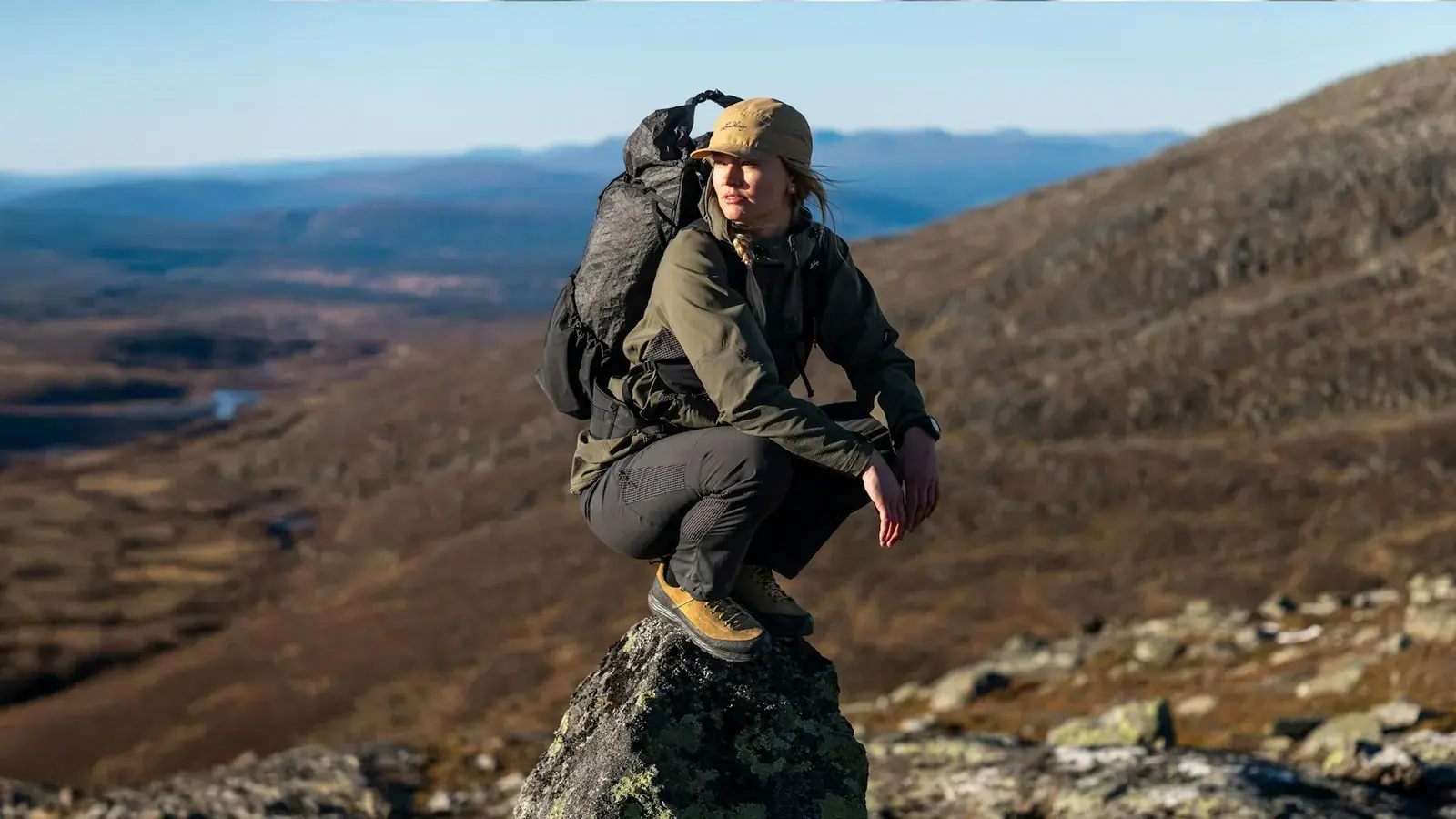
Founded in Sweden's Jämtland wilderness in 1932, Lundhags builds repairable gear for wet fells and multi-day treks. Learn how membrane-free 1-layer and 3-layer shell boots work, how Makke compares to Authentic III, and how sizing and care work.
The essentials at a glance
- 01
Shoemaker Jonas Lundhag opened his first workshop on the island of Frösön in Jämtland, Sweden, in 1932 at the age of 16. The brand still operates its own cobbler and repair workshop in Järpen.
- 02
Classic Lundhags shell boots skip sewn-in waterproof membranes and thick foam linings: a waterproof Certech cellular rubber base seals out bog water below, the leather shaft dries fast, and two pairs of wool socks regulate warmth.
- 03
Across trekking trousers, LPC (Lundhags Polyester Cotton) blends 65% certified recycled polyester with 35% organic cotton according to Lundhags, paired with Schoeller stretch panels; Makke fits slim and athletic, while Authentic III offers a roomier, heavier-duty cut.
- 04
When sizing shell boots, add roughly 2 cm of extra length beyond your measured foot to accommodate a thin merino liner plus a thicker wool sock, and choose between Slim/Narrow, Medium and Wide lasts.
Anyone who has walked three consecutive rainy days across Scandinavian peat bogs knows the weak spot of heavily padded membrane boots. Once water pours over the cuff or sweat saturates the foam lining, those boots stay wet and freezing inside a tent for days. Tackling that exact Nordic reality is why Lundhags has engineered footwear differently for more than nine decades.
Instead of trapping moisture inside thick fixed linings, the Swedish shoemaker applies clothing's layering principle directly to your feet. That same modular, repair-ready mindset runs through its hybrid trekking trousers around Makke and Authentic, its merino wool pile midlayers and its mountain backpacks.
The brand began in northern Sweden's mountain country. In 1932, 16-year-old shoemaker Jonas Lundhag set up a small cobbler's workshop at his family home on Frösön near Östersund in Jämtland. His early customers were foresters, reindeer herders and mountain travellers who spent weeks crossing wet marshes, birch forests and windswept plateaus. Noticing how often forest workers suffered from back pain, Jonas trained in orthopaedics and began shaping custom arch supports inside his shop.
In 1960, Lundhags formally introduced the boot style that defines its name to this day: the Scandinavian shell boot. Every component followed two strict rules: dry fast in damp mountain weather and allow a cobbler to replace worn parts years later. Now part of Brav Sweden AB, Lundhags continues to run its own factory cobbler and repair workshop in Järpen, Jämtland, servicing boots, garments and packs.
A Lundhags shell boot separates waterproofing from insulation. Around the foot and toes sits a completely waterproof lower shell made from cellular rubber (Certech / Certech EXP), reinforced on modern models with tough Liba Smart expanded TPU and bonded to a lugged Vibram outsole. Above that rubber base rises a full-grain or nubuck leather shaft with no waterproof membrane inside.
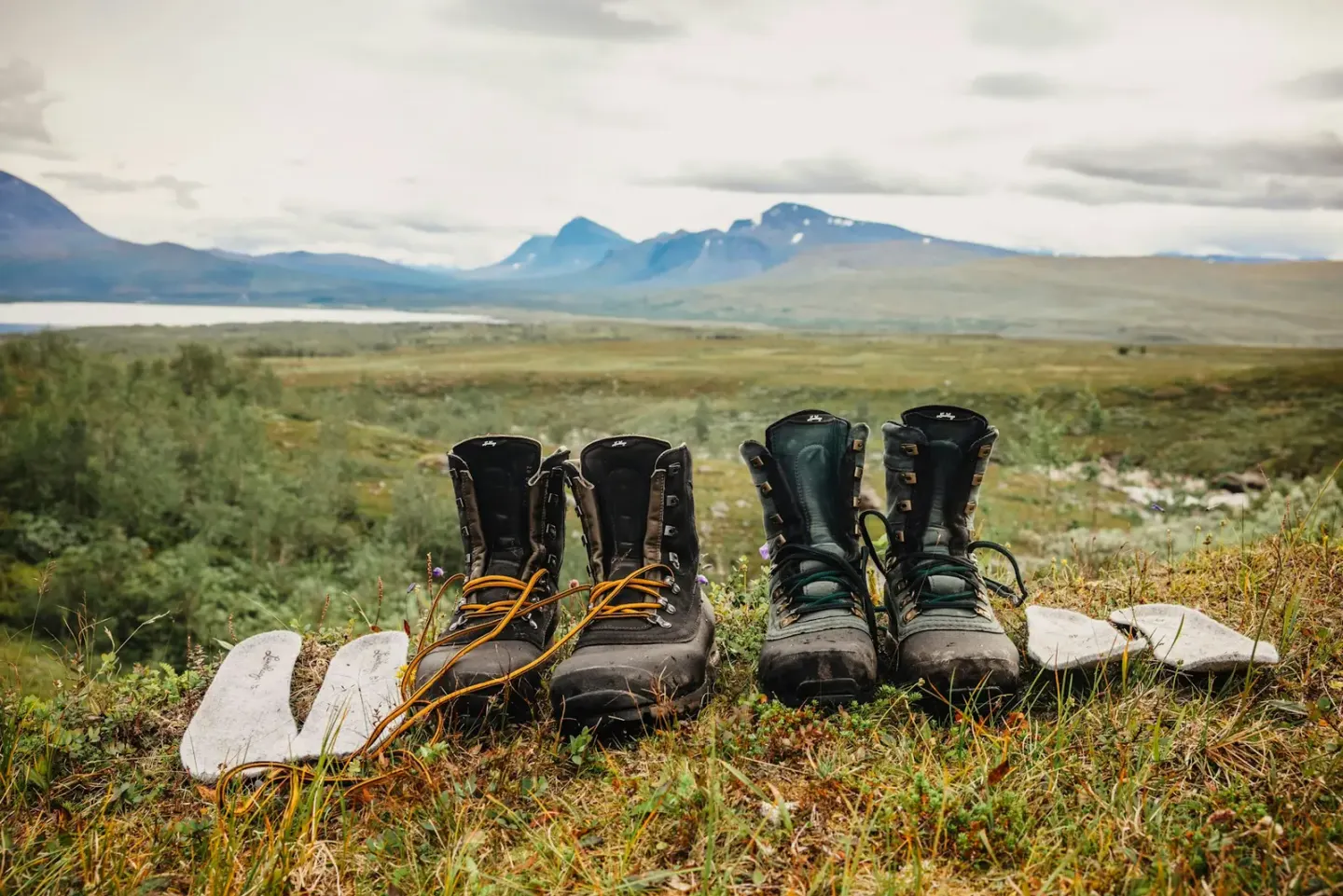
Padding and warmth come from the two-sock principle rather than fixed foam: against your skin sits a thin merino liner such as the Lundhags Merino Liner Sock, topped by a thicker wool trekking sock. Friction occurs between the two sock layers instead of rubbing your heel. When your socks get damp, you swap in a dry pair from your pack in two minutes and stand the removable wool-felt insole upright inside the cuff overnight.
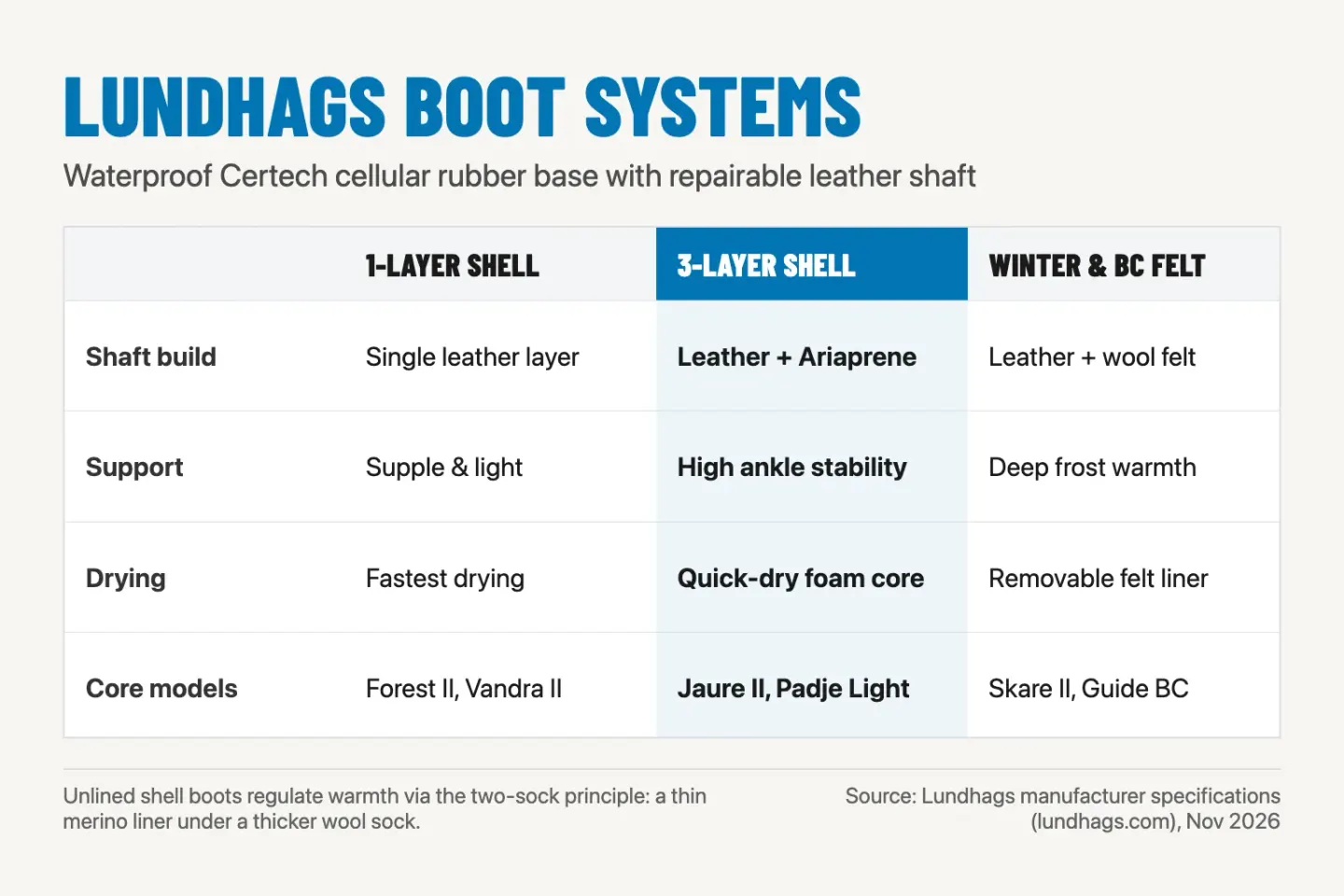
1-layer versus 3-layer trekking shell boots
Within unlined three-season trekking boots, Lundhags builds two distinct shaft structures that feel noticeably different on the trail:
- 1-layer shell boots: The shaft consists of a single thick piece of full-grain or nubuck leather (often Heinen Terracare). With zero foam in the cuff, the boot stays lighter, moulds closely around your ankle after break-in and dries faster than any multi-layer boot. Core examples in our range include the high-cut Lundhags Forest II, the versatile Lundhags Vandra II Mid, the roomier Lundhags Vandra II High Wide and the everyday Lundhags Park.
- 3-layer shell boots: Between the outer leather and an abrasion-resistant microfibre lining sits a closed-cell layer of Ariaprene synthetic foam, paired with Heel Fit Control (HFC). Closed-cell Ariaprene absorbs virtually no water while adding firm ankle support under heavy trekking packs above 15 kg. Standout models include the flagship Lundhags Jaure II Ms High Wide, the nimble Lundhags Padje Light Trekking Boot Mid M and the slim-lasted Lundhags Tjakke II Trekking Boot Mid Narrow.
Winter boots, backcountry ski boots and cushioned trail shoes
Once temperatures stay below freezing, Lundhags pairs its cellular rubber shell with a removable wool-felt inner boot (70% wool, 30% polyester according to Lundhags). The mid-cut Lundhags Skare II Mid (around 880 g) combines Perwanger suede and a Certech rubber base with a Vibram Mottarone Arctic Grip outsole for icy winter ground. For deep sub-zero expeditions, the Lundhags Skare Expedition Ws adds Aerogel underfoot insulation.
Backcountry ski touring and Nordic ice-skating boots follow the exact same removable-liner logic: the Lundhags Guide BC and taller Lundhags Guide Expedition BC click into Rottefella NNN-BC bindings, whereas the Lundhags Abisku Expedition Xplore Ski Boot is built for the Rottefella Xplore system.
If you prefer cushioned underfoot comfort right out of the box for forest paths and day hikes, look to Tived Trail and Bjerg II. Both the low-cut Lundhags Tived Trail Shoe M (420 g per shoe in EU 42) and mid-cut Lundhags Tived Trail Boot M combine suede uppers, a protective Liba Smart mudguard and a high-rebound EVA midsole while remaining resoleable.
Alongside boots, technical hybrid trousers represent Lundhags' biggest apparel pillar. Nearly every pant starts with LPC (Lundhags Polyester Cotton): according to Lundhags, this tightly woven fabric blends 65% certified recycled polyester with 35% organic cotton and carries a 100% PFAS-free DWR finish. Dense weaving blocks cold wind and light drizzle while letting sweat vapour escape far more freely than a membrane shell.
To keep high steps and scrambles unrestricted, Lundhags maps 4-way stretch panels made from Schoeller Dryskin or Schoeller Dynamic across the knees, seat and gusset.
Lundhags trekking trouser lines compared
| Feature | Makke PantBestseller | Makke Lt / Makke Pro | Authentic III Pant | Fulu Cargo Stretch Hybrid |
|---|---|---|---|---|
Cut & silhouette | Slim / athletic fit | Slim (Lt lighter, Pro winterised) | Regular / classic trekking fit | Regular fit with thigh cargo pockets |
Weight (men's medium) | approx. 495 g | Lt lighter / Pro heavier | approx. 560 g | approx. 470 g |
Main fabrics & stretch | LPC + Schoeller Dryskin + Keprotec | Lighter LPC or 3-layer weather zones | Heavier LPC + Schoeller Dynamic | LPC + extended stretch panels |
Best suited for | Active three-season hill & mountain hikes | Warm summer treks (Lt) or wet cold (Pro) | Multi-day backpacking with heavy loads | Everyday hikes, camp work & bushcraft |
Both the Lundhags Makke Ms Pant and Lundhags Makke Ws Pant feature a trim athletic cut, reinforce the inner ankles with tough Schoeller Keprotec against boot and rock abrasion, and integrate three separate ventilation zip zones along the inner thighs, hand pockets and lower legs. Summer hikers can drop weight with the Lundhags Makke Lt Ms Pant, while cold-weather trekkers gain waterproof 3-layer panels on exposed zones in the Lundhags Makke Pro Ws Pant.
Hikers who find the Makke too snug through the thighs usually prefer the Lundhags Authentic III Pant M, which pairs a roomier regular cut with heavier LPC fabric. Extra pocket capacity comes on the Lundhags Fulu Cargo Stretch Hybrid Pant M, whereas fast-packing hikers opt for the streamlined Lundhags Padje Light Vent Pants M.
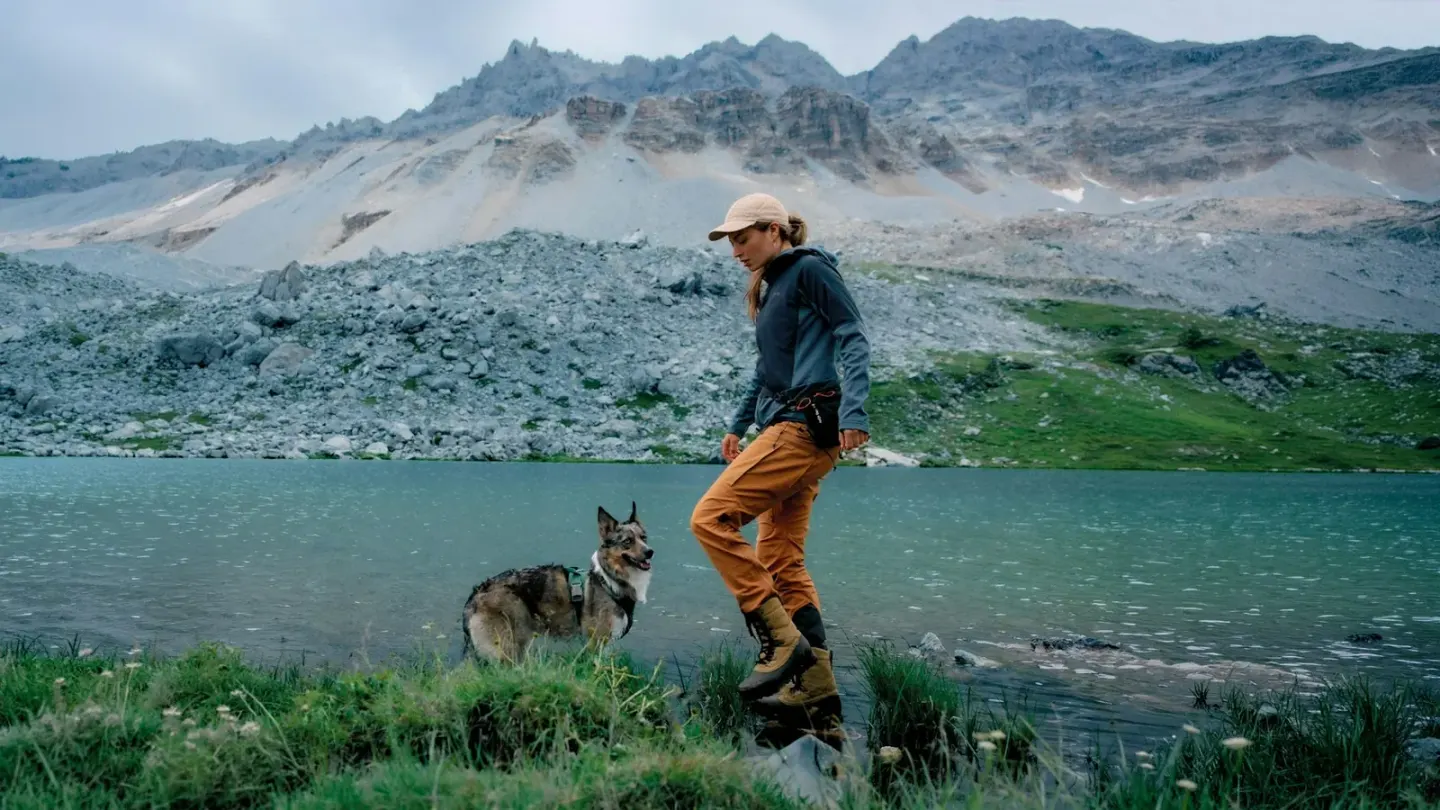
Upper-body layers build on the same fabric toolkit. Trekking jackets like the Lundhags Authentic III Jacket M combine waxed LPC shoulders with stretch panels for pack comfort, while waterproof shells such as the Lundhags Ocke Ms Jacket step in when mountain storms set in. For frosty camp evenings and daily winter wear, the long Lundhags Knak Pile Ms Parka pairs waxed 65/35 polycotton with PrimaLoft synthetic insulation (100 g/m², 100% polyester according to Lundhags) and teddy pile lining; the hip-length Lundhags Järpen Pile Jacket M (1,214 g) applies the same cosy hybrid mapping.
Among midlayers, the Flok series stands out: the Lundhags Flok Wool Ms Pile and women's version blend mulesing-free merino wool (21.5 micron according to Lundhags) with polyester into a lofty fleece that insulates even when damp. Underneath sit soft next-to-skin knits such as the Lundhags Prime Merino Half Zip M.
On your back, the lineup spans compact everyday and day-hike packs like the Lundhags Rygga 25L (580 g) and Lundhags Artut 26, lightweight Padje Ultralight thru-hiking packs (25 L and 45 L) and heavy-load Gnaur and Saruk expedition packs (60 to 120 L with Carry System 4.0 and glove-friendly metal buckles).
Six core Lundhags picks from our range
From Makke hybrid trousers and shell boots to cushioned trail shoes and merino wool pile
 LundhagsMakke Ms PantSlim-fit hybrid trekking trousers (495 g) in LPC polycotton with Schoeller Dryskin stretch and Keprotec ankle patches.194.85€View product →
 LundhagsTived Trail Shoe MLightweight resoleable suede hiking shoe (420 g) with Liba Smart mudguard and cushioned EVA midsole.226.05€View product →
 LundhagsVandra II High WideClassic 1-layer shell boot on a wider last with waterproof Certech cellular rubber base and Vibram Traction sole.331.35€View product →
 LundhagsSkare II MidMid-cut winter shell boot (880 g) featuring a removable wool-felt inner boot and Vibram Arctic Grip outsole.319.65€View product →
 LundhagsJärpen Pile Jacket MWarm cold-weather jacket mapping teddy pile across torso and hood with insulated sleeves.284.55€View product →
 LundhagsFlok Wool Ms PileLofty merino wool blend pile midlayer (21.5 micron) built for trails, mountain huts and everyday cold.140.25€View product →
Scandinavian shell boots shine across bogs, multi-day tent trips and sub-zero winters, yet they ask for active participation. Stepping into an unlined 1-layer leather boot with a single thin cotton sock expecting sneaker-like softness will quickly lead to heel rub. Full-grain leather needs gradual break-in, and the two-sock system of merino liner plus wool sock is structural rather than optional.
The same honesty applies to LPC trekking trousers. Makke, Authentic III and Fulu Cargo breathe vastly better uphill than waterproof rain pants and shrug off wind and brief showers. During hours of sustained mountain rain, however, polycotton eventually wets through; carry lightweight shell overtrousers such as the Lundhags Tived Waterproof Pant M in your pack for full storm days.
Matching the right Lundhags setup to your trip
- 1
If you carry a heavy multi-day pack across wet, uneven ground
choose a 3-layer shell boot like Jaure II or Padje Light for structured ankle support.
- 2
If you hike with lighter loads and want the fastest drying time
pick a classic 1-layer shell boot such as Vandra II or Forest II.
- 3
If you want a trim, heavily ventilated pant with maximum stretch
go for the Makke Pant (available in Short, Regular and Long); choose Authentic III for fuller thighs.
- 4
If you stick to groomed day trails and prefer soft midsole cushioning
pick the Tived Trail Shoe or Tived Trail Boot instead of a traditional shell boot.
Right for you if …
Trekkers and winter backcountry travellers seeking fast-drying, repairable membrane-free boots and breathable hybrid trousers
Probably not for you if …
Walkers wanting instant sneaker cushioning with a single cotton sock or expecting polycotton trousers to replace waterproof rain pants
Proper shell boot sizing hinges on leaving room for sock volume and downhill toe clearance. Lundhags advises standing barefoot or in a thin liner sock with your heel flat against a wall, measuring your longer foot and adding 2 cm of extra space before checking the EU 35 to 48 size chart. Between two sizes, size up. Depending on the model, Lundhags also offers three distinct lasts: Slim/Narrow (such as Tjakke II Narrow), Medium/Regular and Wide (such as Vandra II High Wide or Jaure II High Wide).
For trekking trousers (women EU 34 to 46, men EU 46 to 58), built-in leg lengths spare you tailoring: core styles like Makke come in Regular, Short (roughly 5 cm shorter inseam, e.g. Lundhags Makke Ms Pant Short) and Long (roughly 5 cm longer, e.g. Lundhags Makke Ms Pant Long), alongside D-sizes with a roomier waist-to-inseam ratio.
To keep boots and LPC garments working across decades, Lundhags highlights four care habits:
- Proof the leather shaft, skip the rubber: Treat leather uppers regularly during your first three to four hikes using Lundhags Leather Grease (softens full-grain leather deeply) or Lundhags Leather Wax (maintains firmer structure). Leave the Certech cellular rubber lower ungreased.
- Dry gently below 40 °C: Pull out the wool-felt insoles after every walk and never dry wet boots next to campfires, stoves or radiators above 40 °C, as high heat cracks leather and weakens sole bonds.
- Ease stiff cuffs gradually: If tall leather shafts feel rigid on early walks, leave the top two or three lace hooks unfastened until the ankle flexes naturally.
- Use the Järpen repair workshop: Worn Vibram outsoles, damaged cellular rubber bottoms, bent lace hooks or broken trouser zips can be replaced by Lundhags' own cobblers and seamstresses in Järpen.
Explore the full Lundhags range
From 1-layer and 3-layer shell boots and winter footwear to Makke and Authentic trekking trousers, merino pile and mountain packs.
Shop all Lundhags productsFrequently asked questions
Why do Lundhags shell boots skip waterproof membranes like Gore-Tex?
A fixed membrane paired with thick foam keeps water out initially, yet takes days to dry inside a tent once water enters from above or sweat builds up. Lundhags combines a completely waterproof cellular rubber lower with an unlined, waxed leather shaft instead: if your feet get damp, you simply swap in dry wool socks and air out the felt insole.
What is the difference between Lundhags 1-layer and 3-layer shell boots?
1-layer boots such as Forest II and Vandra II use a single thick layer of leather in the shaft, making them lighter, more supple and the quickest to dry. 3-layer boots like Jaure II, Tjakke II and Padje Light sandwich closed-cell Ariaprene foam and microfibre behind the outer leather, adding substantial ankle support under heavy packs.
How should I size Lundhags shell boots?
Stand with your heel against a wall in a thin sock, measure your longer foot and add around 2 cm to allow for the two-sock principle (thin merino liner plus thicker wool sock) and downhill toe room. If you sit between sizes, go up, and match your foot width to Slim/Narrow, Medium or Wide lasts.
How does the Lundhags Makke Pant differ from the Authentic III Pant?
The Makke Pant features a slim athletic cut (approx. 495 g in men's medium), extensive Schoeller Dryskin 4-way stretch zones, Keprotec inner-ankle patches and three ventilation zip zones. The Authentic III Pant uses a roomier regular cut and heavier LPC fabric (approx. 560 g) for added wind protection on multi-day backpacking trips.
Can Lundhags boots and trousers be resoled or repaired?
Yes. Lundhags operates its own cobbler and sewing repair workshop in Järpen, Sweden. Their craftspeople replace worn Vibram outsoles, rebuild cellular rubber lower shells and repair hooks, seams, pack buckles and garment zippers.
Sources (6)
- About Lundhags: shoemaking heritage in Jämtland since 1932 ↗
- Lundhags Boot Guide: About our shell boots ↗
- Lundhags Buying Guide: How to choose hiking boots ↗
- Lundhags Boot Material Guide: Certech, leathers & Vibram ↗
- Lundhags Clothing Guide: LPC PolyCotton Mix in depth ↗
- Lundhags Repair Services in Järpen ↗
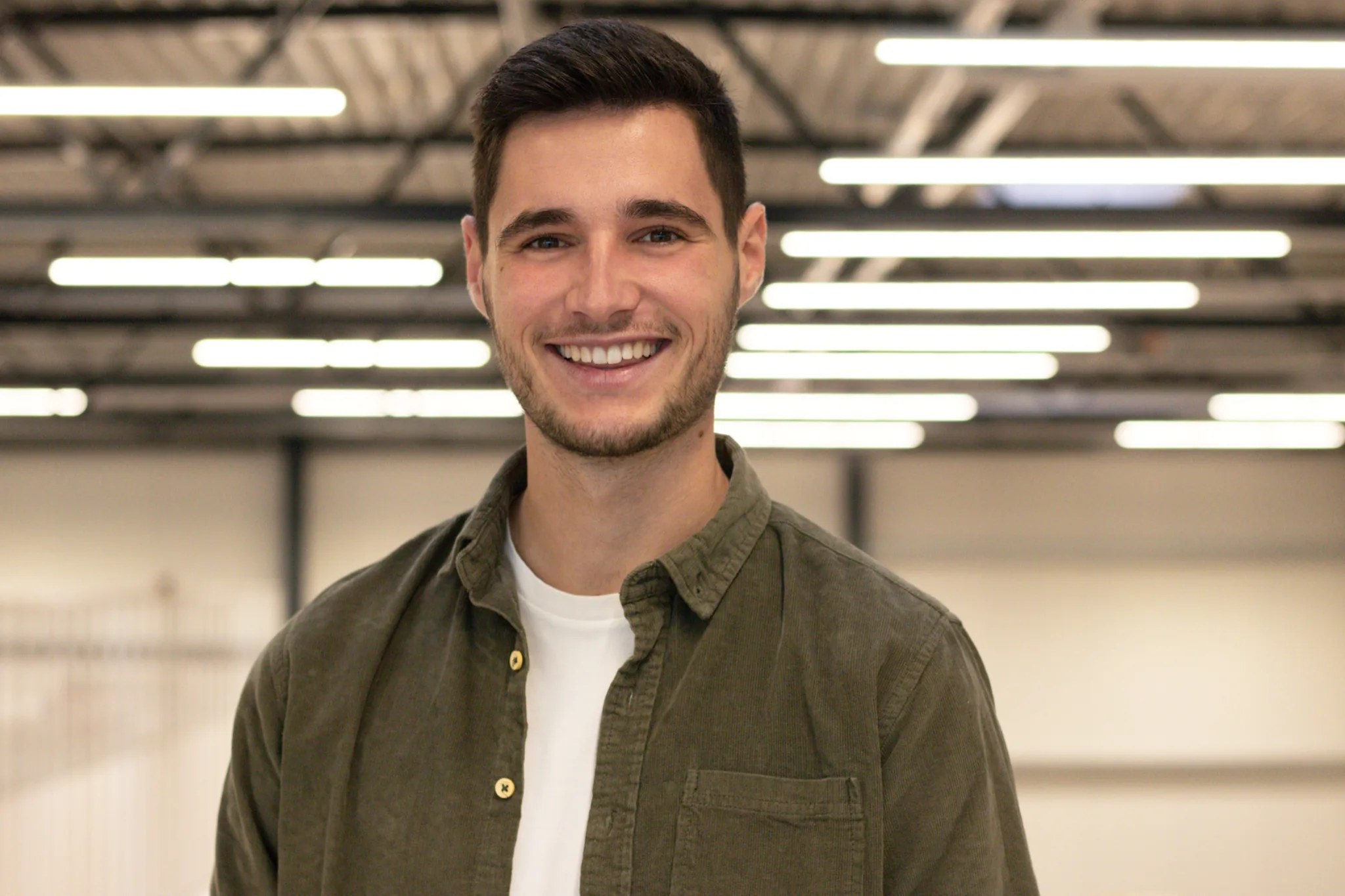
SportFits editorial team
Marketing & Sales Manager at SportFitsNiklas is Marketing & Sales Manager at SportFits and studied applied sports science in Regensburg. In the magazine he writes about training science, fitness and longevity, putting trends into scientific context instead of simply celebrating them. He also looks at what really matters in outdoor gear: honest facts instead of empty advertising language.
Author profile →SportFits
outdoors looks good on you