Stories
Maloja: cembra® shells, cycling chamois pads and lines explained
In partnership withMaloja
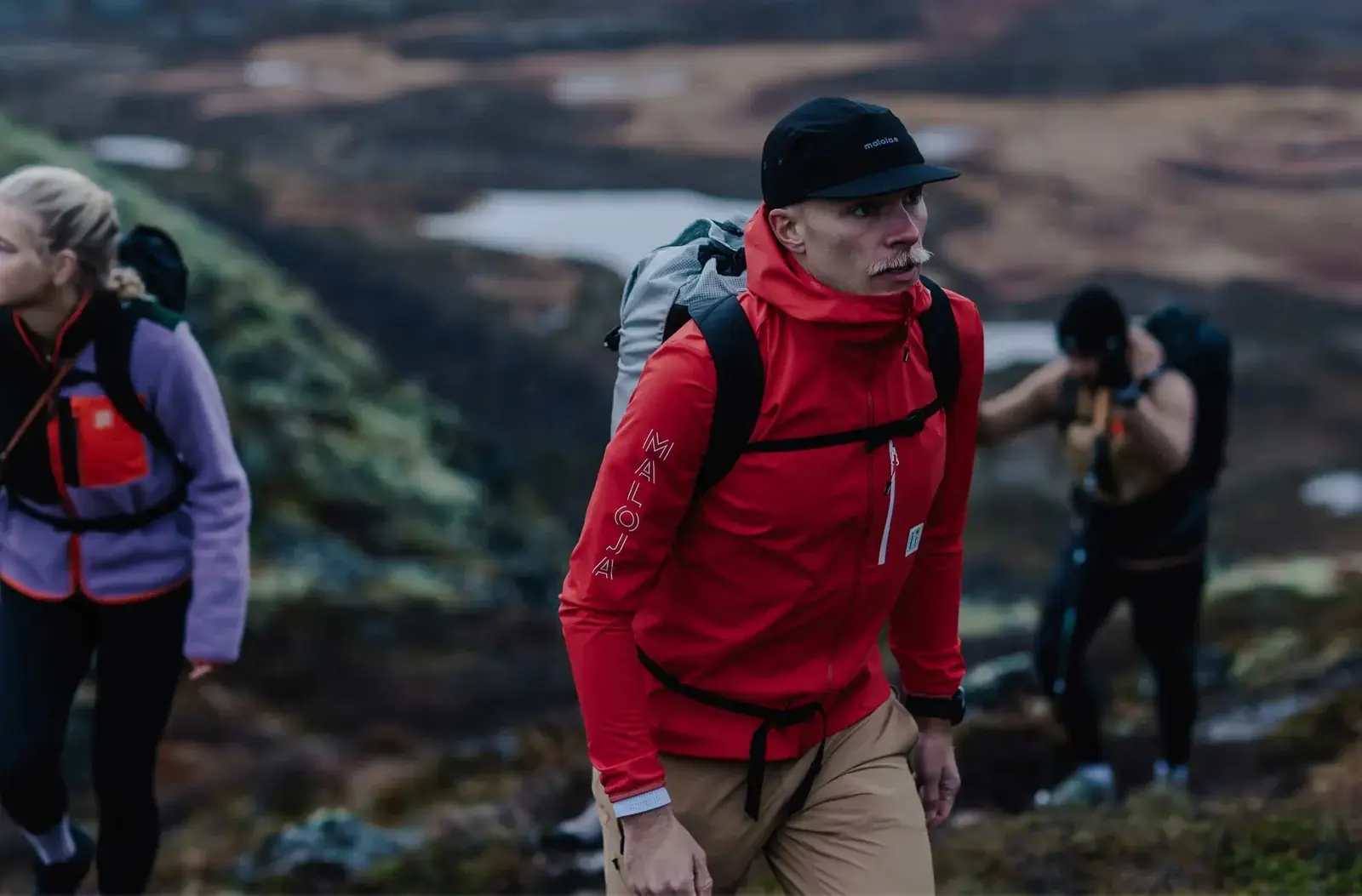
Inspired by a quiet rope tow at Switzerland's Maloja Pass in 2001 and founded on a Bavarian farmhouse in 2004, Maloja builds technical gear for ski touring, Nordic skiing and cycling. Here is how its five cembra® laminates, three bib chamois tiers and sizing work.
The essentials at a glance
- 01
Peter Räuber and Klaus Haas founded Maloja in Upper Bavaria's Chiemgau region in 2004, naming the company after an untracked 2001 powder day at a small rope tow in the Swiss village of Maloja.
- 02
According to Maloja, roughly 70 percent of its apparel is manufactured in Europe, led since 2014 by its wholly owned Bulgarian factory Viomoda (~270 staff) alongside cycling specialists in northern Italy.
- 03
Under the cembra® name, Maloja groups five proprietary weather-protection laminates: RESIST (22,000 mm) and LIGHT (15,000 mm) 3-layer hardshells, insulated 2-layer SHELTER (10,000 mm), plus windproof BREATHE and STORM for high-output endurance sports.
- 04
Cycling bib shorts and tights split into three clear tiers: Core (Peak/Icon Pad), Endurance (Liberty/Freedom Pad with S.A.T. shock absorption or Eco Breeze) and Pro (high-compression fabrics up to the firm SQlab 11 pad).
Clip into cross-country skis on a frosty morning track, then roll out on dry south-facing gravel roads the same afternoon: in the foothills of the Alps, athletes often switch sports faster than the weather shifts. That exact rhythm shapes Maloja, a Bavarian outdoor and cycling brand known for pairing technical mountain construction with independent cuts and seasonal artwork.
Browse the range and one tiny detail stands out immediately behind almost every product name: a capital letter followed by a full stop, as in MilaunM., LoaM., CristinaM. or ViturinU.. That suffix marks Maloja's naming system: M. identifies gender-specific women's or men's cuts, while U. denotes unisex styles. Deciphering the fabric labels underneath takes a little more context, especially when choosing between cembra® SHELTER, BREATHE, STORM, Thermal Stretch and three different chamois grades. Once you know how those building blocks fit together, picking the right layer becomes straightforward.
Despite its Upper Bavarian home, Maloja takes its name from a pass village 17 kilometres southwest of St. Moritz in Switzerland's Engadin valley. During the snow-heavy winter of 2001, future founders Peter Räuber and Klaus Haas spotted an online photo of a snowboarder airborne in deep powder, captioned simply "Maloja". Curious, they drove there on the final day of an Engadin trip. They found a steep, pine-dotted slope buried under half a metre of fresh snow and a stationary platter lift. Just as they began hiking up on foot, the lift operator creaked open his hut door and switched the engine on just for them.
Among their circle of friends, "maloja" soon became shorthand for any memorable day outdoors. In 2004, Räuber and Haas turned that memory into an independent sports and streetwear company based on a converted farmhouse in Bach near Rimsting, close to Lake Chiemsee. Starting with its debut line ("Soul in the woods"), the design team has built every annual collection around a fresh cultural or geographic theme. Even the refined company emblem reflects that founding story: a full moon, a tree, a curved line readable as either a ski track or singletrack trail, and an individual path running through the wordmark.
Equally distinctive is how close Maloja keeps its production. According to the brand, around 70 percent of all garments are made in Europe:
- Bulgaria (Viomoda): Since 2014, Maloja has operated Viomoda as a wholly owned subsidiary employing roughly 270 people. Most technical sportswear is cut and sewn there, right up to the bonded race suits worn by the U.S. Biathlon team.
- Italy and Portugal: Road and gravel cycling kit, chamois pads and all fleece fabrics come primarily from specialist mills and workshops in Italy, while cotton streetwear is sewn by around seven family-run partners in Portugal.
- Asian technical specialists: Roughly 30 percent of the line, mainly complex 2- and 3-layer shells, down-proof weaves and packs, is produced near specialist fabric mills in China and Vietnam.
- Textile standards: Maloja joined bluesign® as a system partner in 2010; according to the company, roughly 75 percent of its technical fabrics currently carry bluesign® certification.
To handle snow, alpine wind and rain under its own roof, Maloja engineered the cembra® shell series. The name comes from Pinus cembra, the Swiss stone pine capable of withstanding sub-zero storms near the treeline for up to a thousand years. According to Maloja, all five cembra® laminates use a water-repellent DWR finish without the deliberate use of PFAS, and four of them (RESIST, LIGHT, SHELTER and STORM) are built as polyester mono-material laminates designed for end-of-life textile recycling.
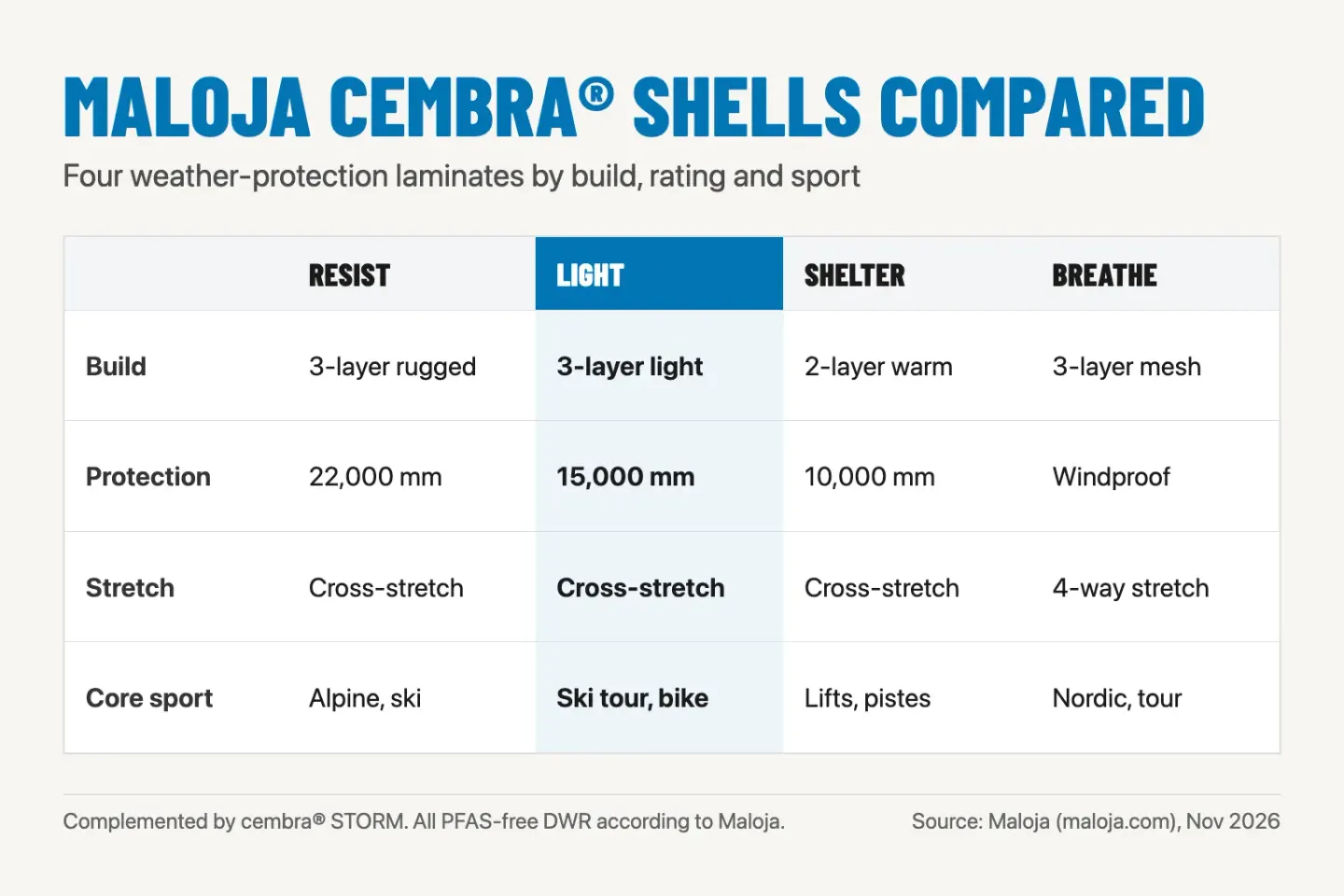
On the mountain, the five tiers divide cleanly by waterproof rating, insulation and vapour transfer:
- cembra® RESIST (Mountaineering & freetouring): Maloja's toughest 3-layer hardshell, delivering a 22,000 mm water column, cross-stretch and, according to the brand, 75 percent recycled polyester. Built for wet snow, rock abrasion and exposed alpine ridges.
- cembra® LIGHT (Ski touring & wet-weather riding): A low-bulk 3-layer waterproof shell with a 15,000 mm water column, cross-stretch and 50 percent recycled polyester according to Maloja. Ideal when low pack weight matters on all-winter ski tours or rainy gravel rides.
- cembra® SHELTER (Lifts, piste & cold backcountry): A 2-layer waterproof shell (10,000 mm water column, 100 percent recycled polyester according to Maloja) paired directly with synthetic thermal padding so you stay warm on windy chairlifts without stacking extra midlayers.
- cembra® BREATHE (High-output endurance): Maloja's most breathable 3-layer shell, combining 4-way stretch and full windproofing with a fibre-based mesh membrane structure that, according to Maloja, moves 30 percent more moisture vapour than comparable 3-layer laminates.
- cembra® STORM & Stormshell (Windblock softshell): A quiet, soft cross-stretch laminate with an internal windproof membrane that stops wind chill and sheds light snow or road spray during fast Nordic skiing, ski mountaineering or cycling.
Winter makes the contrast between insulated protection and breathable hybrid mapping especially clear. If your days revolve around ski lifts, powder laps and sub-zero temperatures, look to padded cembra® SHELTER styles. Both the Maloja LoaM. Women's Ski Jacket and the Maloja KeaM. Women's Ski Jacket pair a seam-taped 2-layer shell (10,000 mm water column) with PrimaLoft Black 80 insulation rated at level 4 out of 5 on Maloja's warmth scale. Men get matching weather protection in the PrimaLoft-insulated Maloja RysyM. Ski Jacket (10,000 mm). Down below, the Maloja HanaleiM. Women's Ski Pants (PrimaLoft Black 40, integrated snow gaiters) and the Maloja BenneM. Men's Ski Pants add side ventilation zips for warmer spring runs.
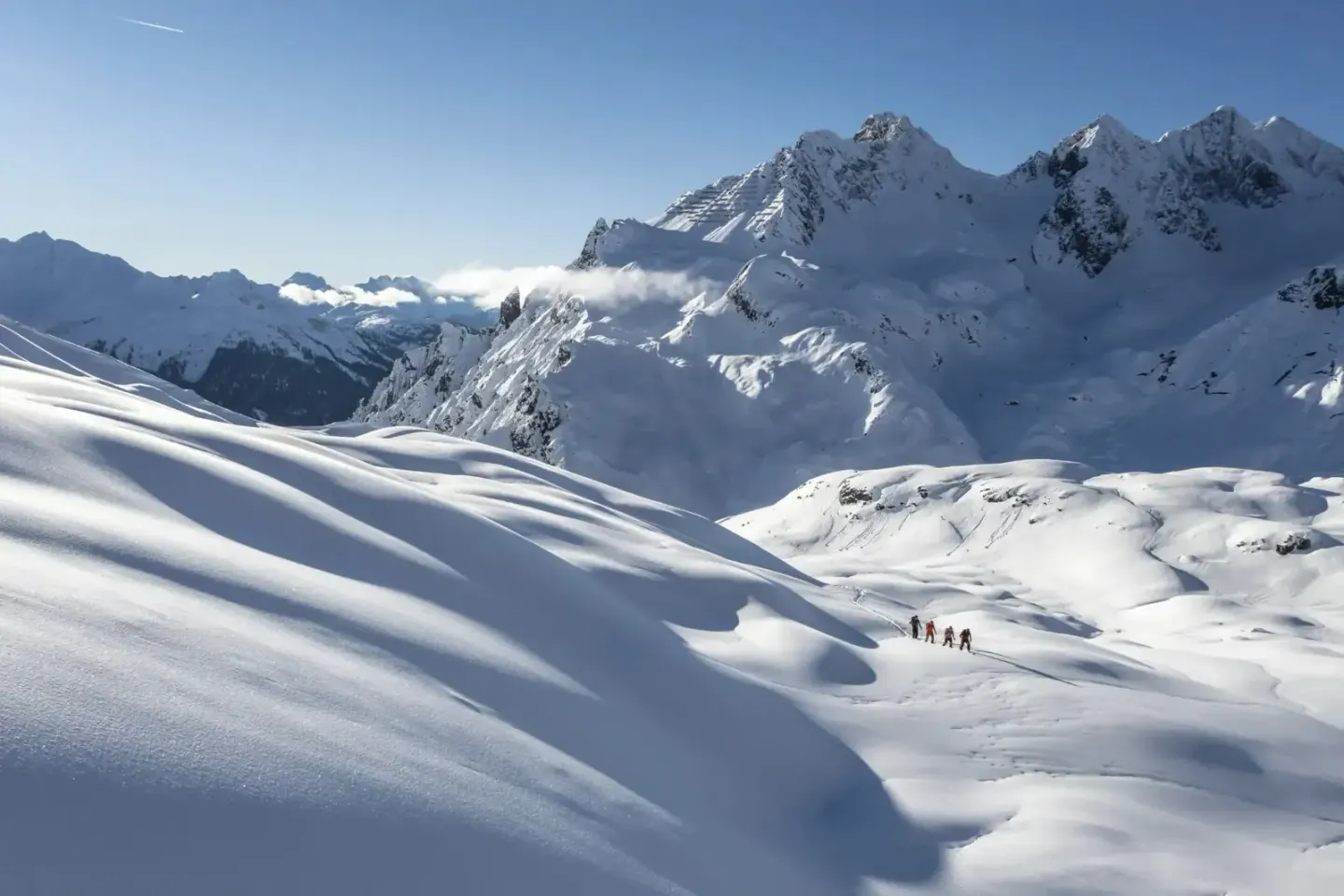
Earn your turns on skins and the equation flips: a fully insulated ski jacket overheats within twenty minutes on a steep uptrack. For ski touring and Nordic skiing, Maloja relies heavily on body-mapped hybrids, placing windproof cembra® BREATHE or cembra® STORM across the chest and thighs while leaving the back panel and behind the knees open in air-permeable Thermal Stretch or Mountain Stretch.
- Ski touring & ascents: The slim-cut Maloja LoseggM. Women's Ski Touring Pants block headwinds up front with cembra® BREATHE while venting heat through Thermal Stretch (84% polyamide, 16% elastane) and laser-cut perforations. Men can pair the abrasion-resistant Maloja ChalderaM. Ski Touring Pants (92% polyamide, 8% elastane, side vent zips) with the stretchy Maloja SperberM. Hybrid Jacket featuring an integrated face guard. Deep alpine powder days call for the waterproof Maloja MuottasM. Women's Backcountry Pants, while cold summit transitions are where the pull-on Maloja ViturinU. Unisex Insulated Pants shine.
- Nordic skiing & Glide & Ride: Born after co-founder Peter Räuber and a Maloja designer realised they had both skied Nordic tracks in the morning and ridden bikes in the afternoon without changing outfits, the Glide & Ride concept bridges autumn cycling, winter cross-country and spring gravel. Highlights include the Maloja RibiselM. Women's Cross-Country Jacket, the wind-blocking Maloja NeshaM. Women's Vest in cembra® STORM Warm and the Maloja BerndM. Men's Cross-Country Jacket, matched with the Maloja CristinaM. Women's Cross-Country Pants and Maloja MarcusM. Men's Cross-Country Pants.
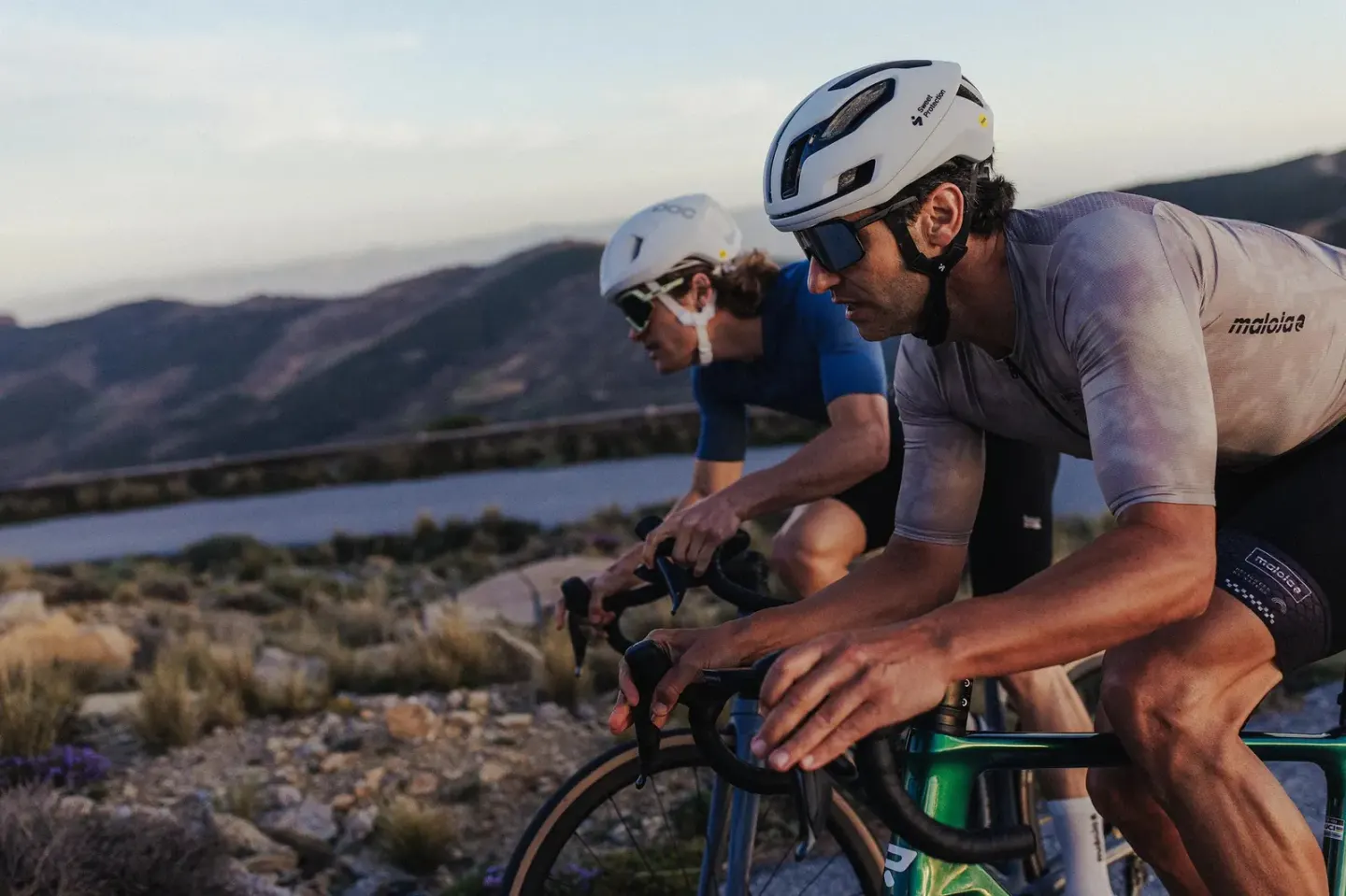
Cycling forms the second major pillar of Maloja's technical line. Tailored in Italy, its bib shorts and cycling tights follow a three-tier structure so riders can match fabric compression and foam density to ride duration.
Maloja cycling bib and chamois categories compared
| Feature | Core | EnduranceLong-distance | Pro |
|---|---|---|---|
Main fabric | Bike Stretch (78% rec. nylon, 22% rec. spandex per Maloja) | Motion Flex (60% nylon, 40% spandex, 4-way stretch) | Bike Stretch HC (71% nylon, 29% spandex, high compression) |
Women's chamois | Peak Pad (plush 3-layer cushioning) | Liberty Pad (S.A.T.) or Speed Ergo Eco Breeze | Liberty Pad, Speed Ergo Eco Breeze or SQlab 11 |
Men's chamois | Icon Pad (plush 3-layer cushioning) | Freedom Pad (S.A.T.) or Hero Ergo Eco Breeze | Freedom Pad, Hero Ergo Eco Breeze or SQlab 11 |
Best suited to | Commutes, relaxed spins, everyday rides | All-day tours needing vibration damping | Fast road, gravel racing and long intervals |
For straightforward saddle comfort on cool rides, the Maloja AlbrisM. 1/1 Women's Cycling Tights integrate the seamless Peak Pad. Mountain bikers who prefer unpadded overshorts that pair with a separate liner can choose the high-waisted Maloja BadusM. Women's MTB Shorts or the adjustable Maloja BardinM. Men's MTB Shorts made from 100 percent recycled polyester according to Maloja. Up top, breathable jerseys and shells such as the Maloja AmerlingM. Men's Long-Sleeve Jersey (94% polyester, 6% spandex), the Maloja BaldoM. Women's Cycling Jersey and the slim-fitting Maloja IdroM. Women's Bike Jacket cover trail and gravel sessions.
Away from membranes and Lycra sits an unexpected bestseller: the Maloja MilaunM. Men's Boiled-Wool Jacket (Walkjanker) crafted from 100 percent virgin wool with staghorn buttons and stretch knit inserts, alongside the women's Maloja AllegriaM.. For hiking, hut evenings and travel, lightweight synthetic and fleece layers such as the PrimaLoft BIO 100 (100 g/m²) Maloja ArtalleM. Women's Jacket, the half-zip Maloja AramM. Men's Fleece and the boxy wool-blend Maloja VallettaM. Jacket round out the range.
Six proven Maloja picks from our shop
From the signature wool Walkjanker and cembra® SHELTER ski wear to Nordic hybrids, ski touring and MTB
 MalojaMilaunM.Classic men's boiled-wool jacket (100% wool) with staghorn buttons and knit inserts for everyday wear.305.85€View product →
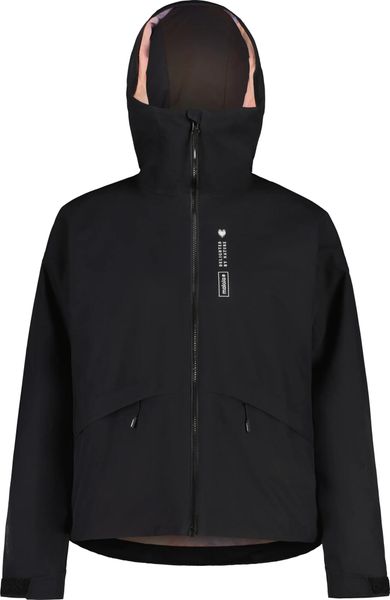 MalojaLoaM.Insulated women's ski jacket in 2-layer cembra® SHELTER (10,000 mm) with PrimaLoft Black 80 warmth.332.35€View product →
 MalojaRIBISELM.Versatile women's Glide & Ride hybrid jacket built for Nordic tracks, running and cool bike rides.162.35€View product →
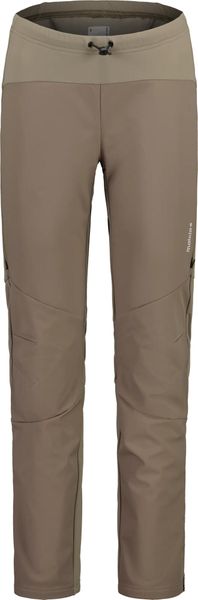 MalojaCristinaM.Windproof women's Nordic hybrid pants in cembra® STORM Warm with stretch back panels and vent zips.157.15€View product →
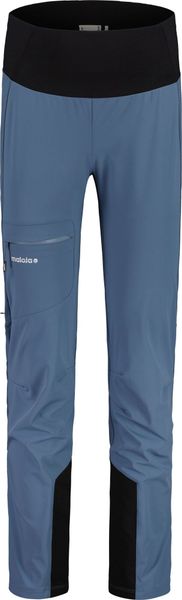 MalojaLoseggM.Slim-cut women's ski touring pants pairing windproof cembra® BREATHE with laser-vented Thermal Stretch.212.35€View product →
 MalojaBadusM.Stretchy, water-repellent women's MTB trail shorts with a supportive high waistband.58.45€View product →
Cross-sport versatility is Maloja's calling card, yet hybrid and softshell garments always involve physical trade-offs. Pieces built with cembra® BREATHE or cembra® STORM block biting wind and shrug off dry snow or brief drizzle, though unsealed stretch panels on the back cannot replace a fully taped hardshell during hours of heavy mountain rain. When sustained downpours or wet glacier snow are on the forecast, step up to 3-layer cembra® RESIST or cembra® LIGHT.
The reverse applies to insulated cembra® SHELTER ski wear like LoaM. or KeaM.: its 10,000 mm shell and fixed PrimaLoft fill excel on cold chairlifts and resort powder days, yet trap too much heat on sustained 1,000-metre ski-touring climbs. Likewise, pure boiled-wool jackets such as MilaunM. and AllegriaM. deliver superb dry-cold warmth in town or at the cabin, whereas wet sleet calls for a waterproof outer shell.
Matching the right Maloja setup to your conditions
- 1
If you face heavy rain, wet snowstorms or exposed alpine ridges
choose 3-layer cembra® RESIST (22,000 mm) or packable cembra® LIGHT (15,000 mm) rather than a hybrid softshell.
- 2
If you work hard on Nordic tracks, skin tracks or gravel climbs
pick body-mapped hybrids combining cembra® BREATHE or STORM up front with Thermal Stretch behind.
- 3
If you ride chairlifts in mid-winter cold and chill easily
2-layer cembra® SHELTER with built-in PrimaLoft padding saves carrying a separate midlayer.
- 4
If you spend four or more hours in the saddle
step up from Core to an Endurance or Pro bib short with S.A.T. shock absorption or a firmer SQlab 11 pad.
Right for you if …
Ski tourers, Nordic skiers and cyclists who value body-mapped breathability, freedom of movement and multi-sport versatility
Probably not for you if …
Riders expecting an unsealed softshell hybrid to survive all-day torrential rain or climbing steep ski-touring tracks in heavy resort insulation
Maloja labels apparel in international sizes from XS to XXL backed by clear centimetre brackets. In women's sizing, XS maps to EU 34 (bust 86-90 cm, hip 90-94 cm), M to EU 38 (bust 94-98 cm, hip 98-102 cm) and XL to EU 42 (bust 102-106 cm, hip 106-110 cm). In men's sizing, S equals EU 46 (chest 93-99 cm, waist 81-85 cm), M equals EU 48 (chest 99-105 cm, waist 85-89 cm), L equals EU 50 and XXL equals EU 54 (chest 116-120 cm). Kids' sizes run from XS (EU 104-110) through XL (EU 152-158).
Watch for two practical fit details when ordering. First, many technical ski touring and cross-country pants, including LoseggM., ChalderaM., CristinaM. and MarcusM., come in two leg lengths per waist size: Regular (marked R, such as MR) and Long (marked L, such as ML or SL) for taller athletes. Second, silhouettes vary intentionally by discipline: road jerseys, bibs and Nordic race pieces sit close to the skin (Slim Fit), whereas MTB trail shorts, freeride shells and streetwear offer a roomier Regular or Relaxed Fit.
Four simple care habits protect membranes, chamois foam and wool across many seasons:
- cembra® shells and softshells: Close all zips and hook-and-loop tabs, turn garments inside out and wash on a gentle 30 °C cycle using liquid sports detergent. Never add fabric softener, which clogs membrane pores and impairs PFAS-free DWR beading.
- Padded cycling shorts: Wash inside a mesh laundry bag at 30 °C max, never wring the foam chamois dry by hand and always air-dry away from radiators or tumble dryers.
- Boiled wool (Walkjanker) and wool blends: Pure wool styles like MilaunM. and AllegriaM. rarely need washing; airing them out overnight in damp outdoor air refreshes the fibres naturally. If needed, follow the sewn-in wool care label strictly.
- Repairs beyond warranty: Alongside its two-year statutory warranty, Maloja operates a dedicated repair service that replaces damaged zips or patches crash tears at fair cost.
Explore the full Maloja collection
From ski touring and Nordic hybrids to cembra® ski jackets, Italian-made cycling kit and boiled-wool classics for women, men and kids.
Shop all Maloja gearFrequently asked questions
Where is Maloja based and where are its clothes made?
Peter Räuber and Klaus Haas founded Maloja in 2004 on a converted farmhouse in Bach near Rimsting in Upper Bavaria's Chiemgau region, naming the company after a 2001 powder day at Maloja Pass in Switzerland. According to Maloja, around 70 percent of production takes place in Europe, led by its wholly owned Viomoda factory in Bulgaria, cycling specialists in Italy and family-run cotton workshops in Portugal.
What is the difference between cembra® RESIST, LIGHT, SHELTER, BREATHE and STORM?
RESIST (22,000 mm water column) and lighter-weight LIGHT (15,000 mm) are 3-layer waterproof hardshells for alpine touring, freeride and heavy rain. SHELTER pairs a 2-layer waterproof fabric (10,000 mm) with built-in synthetic insulation for cold ski days. BREATHE (4-way-stretch 3-layer mesh membrane) and STORM (windproof cross-stretch softshell) prioritise wind protection and rapid moisture release for Nordic skiing, ski touring and cycling.
What does "Glide & Ride" mean at Maloja?
Glide & Ride is Maloja's cross-sport line designed to work equally well on winter cross-country ski tracks ("Glide") and cool autumn or spring bike rides ("Ride") without changing outfits. Typical pieces combine windproof front panels with breathable stretch fabric across the back.
Which Maloja cycling pad should I choose for long rides?
Core bibs and tights with the 3-layer Peak Pad (women) or Icon Pad (men) suit commutes and relaxed rides. For multi-hour tours, step up to Endurance shorts featuring shock-absorbing S.A.T. foam (Liberty or Freedom Pad) or ventilated Eco Breeze pads; Pro models add high-compression fabric and options up to the thin, firm SQlab 11 pad.
What do R and L mean on Maloja pant sizes?
Many Maloja ski touring and cross-country pants are offered in two inseam lengths per waist size: "R" stands for Regular length (for example MR for Medium Regular), while "L" after the size letter indicates Long with an extended leg length (such as ML or SL) at the exact same waist and hip measurement.
Sources (6)
- Maloja: The Story Behind Maloja (Origin & Philosophy) ↗
- Maloja: cembra® Shell Series & Weather Protection Technologies ↗
- Maloja: Material Selection, Cambium UP & Natural Fibres ↗
- Maloja: Production Sites in Europe & Viomoda ↗
- Maloja: Cycling Bib Guide (Core, Endurance & Pro Chamois) ↗
- Maloja: Glide & Ride – Function for Slopes and Trails ↗

SportFits editorial team
Marketing & Sales Manager at SportFitsNiklas is Marketing & Sales Manager at SportFits and studied applied sports science in Regensburg. In the magazine he writes about training science, fitness and longevity, putting trends into scientific context instead of simply celebrating them. He also looks at what really matters in outdoor gear: honest facts instead of empty advertising language.
Author profile →SportFits
outdoors looks good on you