Stories
Falke: Socks, base layers and cushioning levels explained
In partnership withFalke
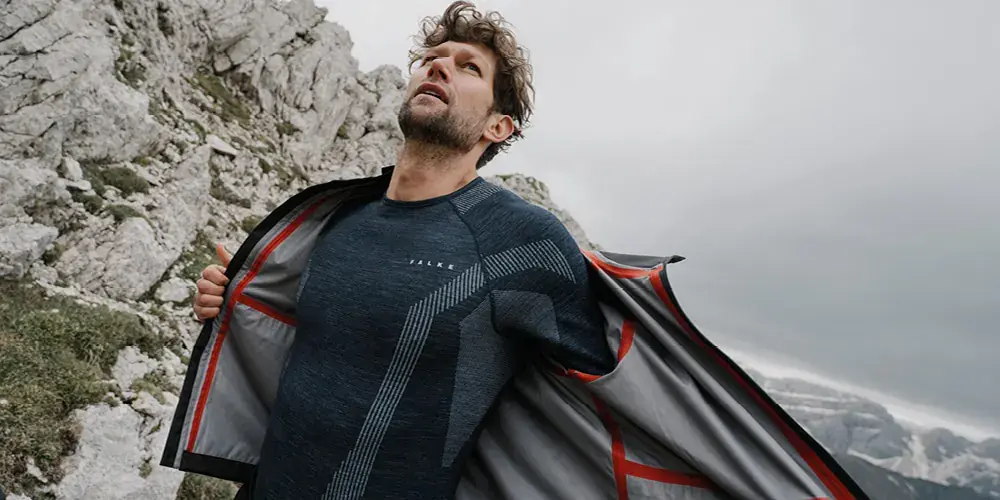
Founded in Germany's Sauerland region in 1895, family-run Falke built the Ergonomic Sport System for skiing, hiking and running. Here is how SK, TK and RU numbers work, how Warm compares to Wool-Tech and how to pick sizes and care for them.
The essentials at a glance
- 01
Franz Falke-Rohen founded the knitting business in Schmallenberg in Germany's Sauerland region in 1895. Four generations later, the family still runs the company from the same town.
- 02
In the 1990s, Falke introduced the Ergonomic Sport System, pairing anatomically knitted left and right toe boxes with a 3-layer moisture-wicking construction.
- 03
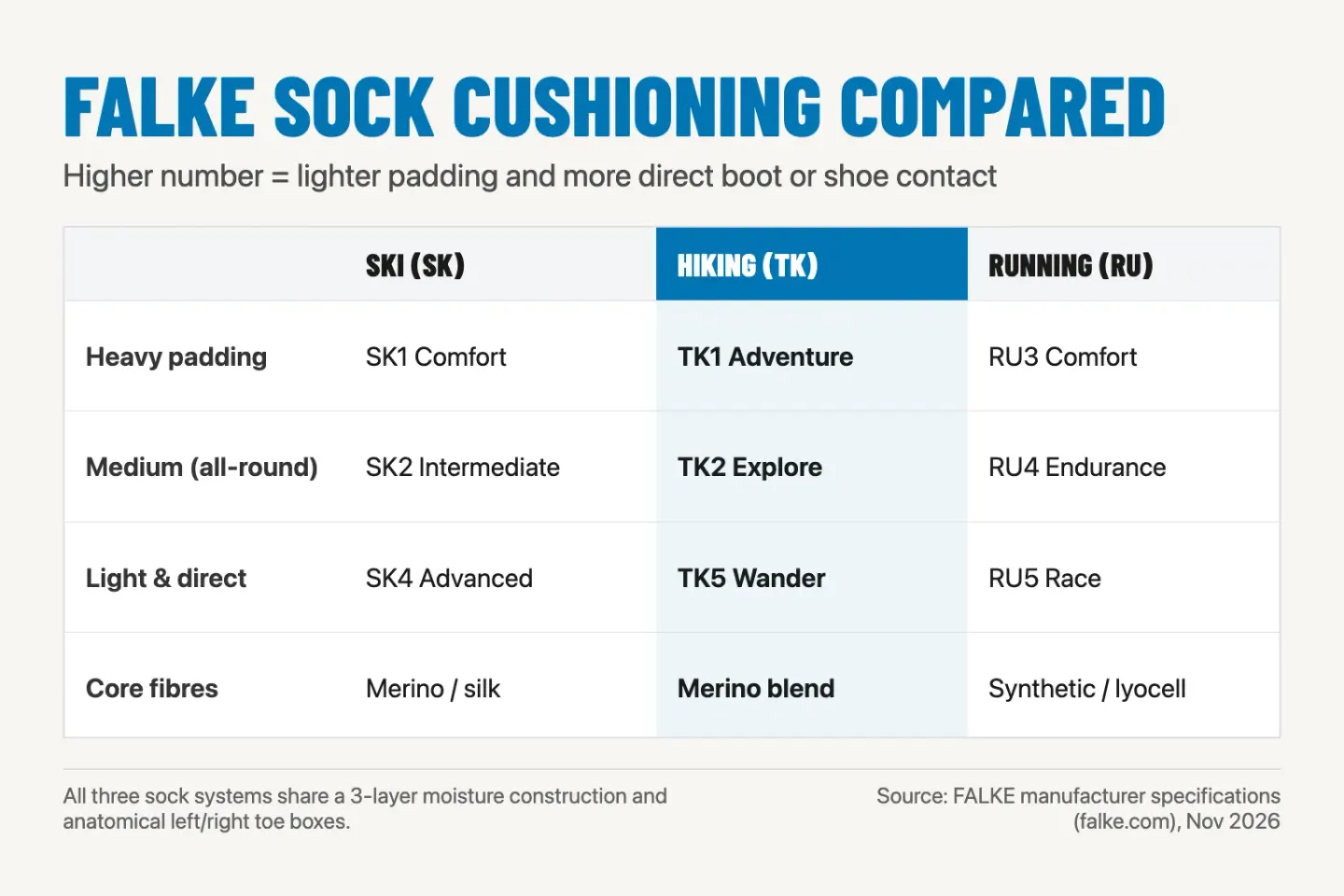
Falke's sock numbering runs in reverse order of padding thickness: higher digits (from SK1 to SK4, TK1 to TK5 or RU3 to RU5) mean lighter cushioning and more direct boot or shoe feedback.
- 04
Base layers split cleanly by fibre and warmth: Warm and Maximum Warm use fast-drying synthetic blends for high output, while Wool-Tech and Wool-Tech Light add merino wool for multi-day odour resistance.
A single folded seam over your pinky toe is enough to cut a ski day short. On a long mountain hike, a damp cotton sock causes blisters faster than a stiff new boot. That narrow interface between skin and footwear is where Falke has focused its engineering for decades.
Open the range and you meet a wall of codes: SK1, SK2, SK4, TK1, TK2, TK5, RU3, RU4, RU5, BC Impulse, Warm, Maximum Warm and Wool-Tech Light. At first glance, the naming looks cryptic. Underneath sits a straightforward grid built around cushioning density, yarn layers and temperature range.
Falke started out of winter necessity. On 8 May 1895, roofer Franz Falke-Rohen opened a small knitting workshop in Schmallenberg in the Sauerland hills because winter snow halted roof work. His son Franz Falke Jr. joined in 1902, and the 1918 purchase of the J. Meisenburg wool spinning mill turned the workshop into an industrial manufacturer. Today the fourth generation still leads the family company from Schmallenberg.
The shift into technical sports gear arrived in the 1990s. Standard tubular socks bunched up inside rigid ski boots and chafed during long runs. Falke answered with the FALKE Ergonomic Sport System: every sport sock receives an individual knit shape for the left and right foot, clearly marked with knitted "L" and "R" letters across the toes.
Most Falke sports socks also rely on a 3-layer construction. Water-repellent polypropylene typically sits close to the skin and pushes sweat outward quickly. Outer and middle layers made from merino wool, polyamide or lyocell absorb that moisture and let it evaporate across a wider surface. Dry skin generates far less friction, which lowers the risk of blisters.
Many shoppers assume a higher number means thicker padding. With Falke, the scale works the opposite way. A low number marks heavy plush cushioning and maximum shock absorption, while a higher number means less volume and closer contact with a snug performance boot or shoe.
Ski socks (SK series): warmth versus power transfer
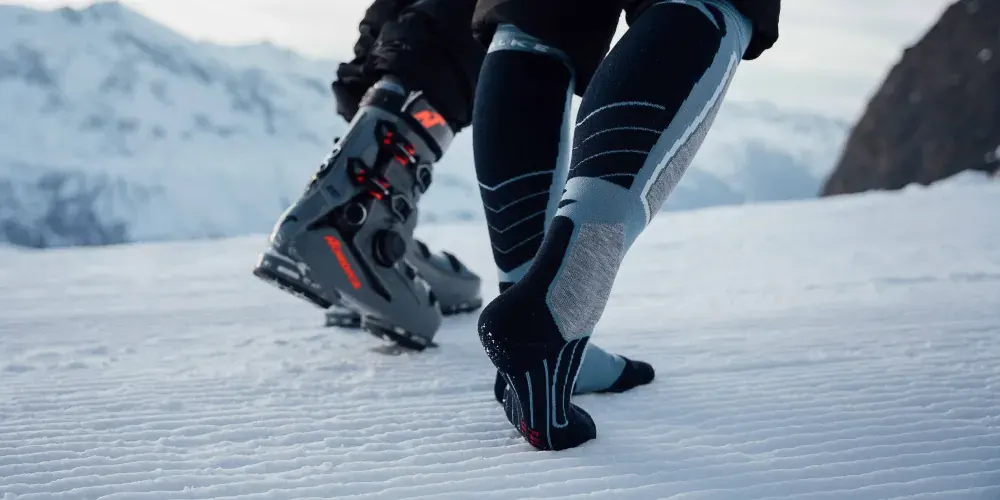
Inside a ski boot, sock volume directly affects both circulation and steering precision. Stuffing a thick sock into a tight performance liner restricts blood flow and often leaves your toes colder than a lighter sock would.
- SK1 Comfort: Heavy padding across shin, ankle and sole, blending merino wool and silk in women's styles such as the Falke SK1 Comfort Women's Skiing Knee-High Socks. Built for relaxed skiing and boots with a bit more room.
- SK2 Intermediate: The medium-padded all-rounder. Both the Falke SK2 Intermediate Men's Skiing Knee-High Socks and the women's version (31% virgin wool, 28% polypropylene, 23% acrylic, 18% polyamide) balance warmth, shin protection and steady boot feel.
- SK4 Advanced: Light cushioning made for athletic skiers and custom-fitted boots. The Falke SK4 Advanced Men's Skiing Knee-High Socks combine 28% polyamide, 27% polypropylene, 23% acrylic, 19% wool and 3% elastane.
Hiking socks (TK series): from light trails to alpine terrain
Match hiking sock volume to boot stiffness and pack weight. A stiff leather mountain boot needs stronger padding than a low-cut trail shoe.
- TK1 Adventure: Heavy cushioning with a merino wool blend for rugged mountain terrain and heavier packs, such as the Falke TK1 Adventure Men's Trekking Socks.
- TK2 Explore: Medium padding for day hikes and rolling hills, available in classic merino blends like the Falke TK2 Explore Women's Trekking Socks (59 g) as well as cooling Cool versions for warm summer days.
- TK5 Wander: Light cushioning for gentle walks, city breaks and flexible leisure footwear, seen in the Falke TK5 Wander Women's Trekking Socks (48 g).
Running socks (RU series) and cycling socks (BC series)
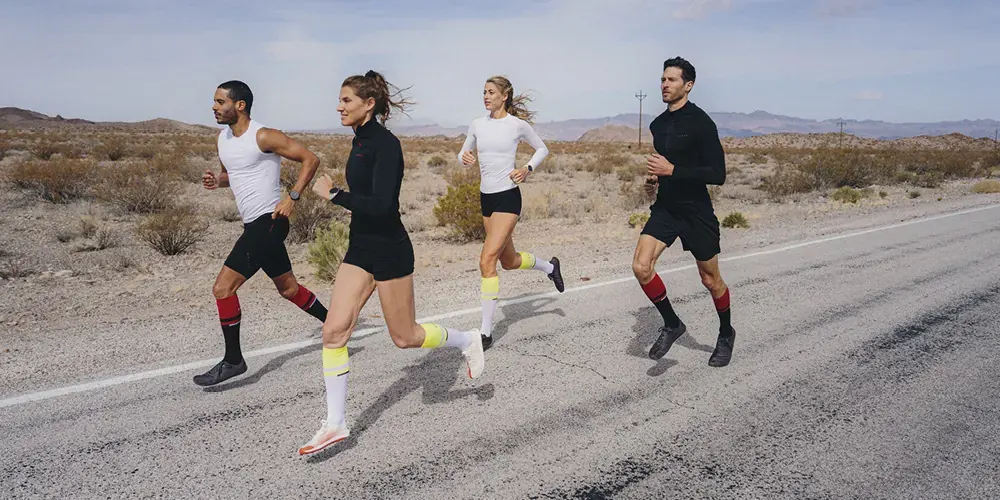
Running loads the heel and forefoot repeatedly with every stride. The RU3 Comfort (such as the Falke RU3 Comfort Men's Running Socks) delivers heavy cushioning for casual runners. For regular training, RU4 Endurance and RU4 Endurance Cool (like the Falke RU4 Endurance Cool Women's Running Socks) pair medium padding with breathable ventilation zones. Race day and tight tempo shoes call for the thin Falke RU5 Race Men's Running Socks (42 g; 38% polyamide, 32% polypropylene, 26% polyester with 23% recycled, 4% elastane).
Cycling applies the same logic through the BC series: the Falke BC Comfort Unisex Biking Socks cushion the pedal zone, the lightweight Falke BC Impulse Unisex Biking Socks (42 g; 51% polyamide, 43% recycled polyester, 4% elastane, 2% polyurethane) integrate stimulating mesh knit zones, and the Falke BC Warm Unisex Biking Socks blend 52% virgin wool with 11% alpaca for winter rides.
Alongside socks, Falke knits close-fitting technical base layers as a first layer against the skin. All three cold-weather lines use a 2-layer structure with body-mapped knit zones: open structures over high-sweat areas like the spine and underarms, denser knitting where you chill easily. Your choice comes down to two variables: ambient temperature and sweat rate.
Falke base layer lines compared
| Feature | WarmAll-rounder | Maximum Warm | Wool-Tech / Wool-Tech Light |
|---|---|---|---|
Temperature range | Mild to cold | Cold to very cold | Cold to very cold (Light: year-round) |
Activity intensity | Medium to high | Medium to high | Low to medium (Light: up to high) |
Core fibres | Polyamide, polyester, elastane | 59% polyamide, 36% polyester, 5% elastane | Merino wool blend with technical fibres |
Key strength | Dries very quickly during high output | Strongest synthetic insulation | Resists odour on multi-day trips |
Styles such as the Falke Women's Warm Long-Sleeve Shirt (69% polyamide, 26% polyester, 5% elastane) and Falke 3/4 Women's Warm Tights focus on rapid moisture transfer during Nordic skiing, ski touring or cold-weather running. When freezing chairlift rides dominate your day, the Falke Men's Maximum Warm Long-Sleeve Shirt and matching Falke 3/4 Men's Maximum Warm Tights step up insulation. Choosing 3/4-length tights avoids overlapping fabric cuffs inside ski boots.
If you spend several consecutive days in mountain huts or chill quickly during stops, look to merino. The Falke Men's Wool-Tech Light Long-Sleeve Shirt and Falke 3/4 Women's Wool-Tech Light Tights buffer moisture inside the wool fibre without feeling clammy and air out overnight.
Six core Falke picks from our range
From SK2 ski socks and TK2 hiking socks to RU4 running socks and cold-weather base layers
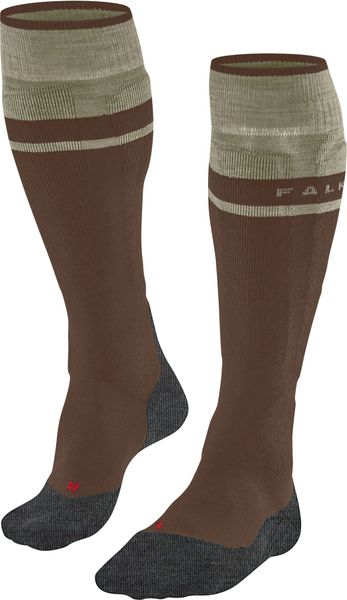 FalkeSK2 Intermediate Herren Skiing KniestrümpfeMedium-cushioned all-round ski sock with merino blend and anatomical L/R toe box.33.15€View product →
 FalkeTK2 Explore Damen Trekking SockenMedium-padded hiking sock (59 g) with merino blend for day hikes and hills.21.55€View product →
 FalkeRU4 Endurance Cool Damen Running SockenBreathable all-round running sock with medium cushioning and cooling fibre zones.18.05€View product →
 WomenFalkeLangarmshirt WarmSlim-fit synthetic base layer (69% polyamide, 26% polyester, 5% elastane) for high-output winter sports.56.85€View product →
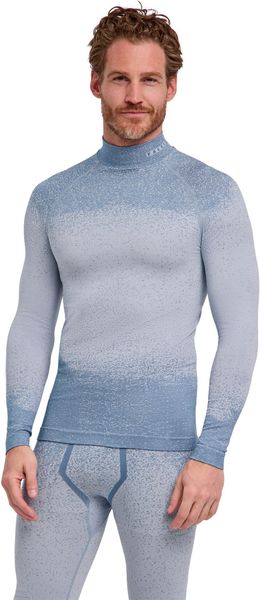 MenFalkeLangarmshirt Maximum WarmHeavyweight 2-layer synthetic top built for sub-zero piste and Nordic days.74.85€View product →
 Falke3/4 Damen Tights Wool-tech Light3/4-length merino blend tights that finish cleanly above ski boot cuffs.72.85€View product →
Falke's grid is precise, yet no single piece suits every setup. A classic ski-boot mistake happens when skiers with snug performance shells buy thick SK1 socks hoping for warmer toes. Extra bulk pinches circulation and blurs edge feel; stepping down to a lighter SK4 sock usually solves both problems.
Fibres also come with clear trade-offs. Merino wool in TK2 or Wool-Tech stays fresher across several days, yet wears faster at high-friction zones than pure polyamide and takes longer to dry in a pack. Conversely, synthetic Warm tops dry rapidly after intense intervals, though they pick up odour sooner than wool blends.
Matching the right Falke setup to your sport
- 1
If you ski in tight, custom-moulded boots
pick lightly padded SK4 instead of thick SK1 to protect circulation and direct edge control.
- 2
If you sweat heavily at high intensity and need quick overnight drying
choose synthetic Warm or Maximum Warm rather than heavy wool.
- 3
If you spend several days in mountain huts without laundry access
opt for Wool-Tech or Wool-Tech Light for natural odour resistance.
- 4
If you buy compression socks such as Ski Energizing
measure your calf circumference (W1 to W4) alongside your shoe size for proper compression fit.
Right for you if …
Skiers, hikers and runners who want clear cushioning grades, wrinkle-free fit and dedicated cold-weather layers
Probably not for you if …
Shoppers looking for one generic sock for every sport or trying to fill oversized ski boots with heavy padding
Technical knitwear only prevents friction when it sits completely smooth. Falke sizes socks in narrow EU brackets: women's socks typically run 35-36, 37-38, 39-40 and 41-42; men's sizes span 39-41, 42-43, 44-45 and 46-48 (up to 49-50 on selected styles); kids' sizes run from 19-22 to 39-42.
Compression styles such as Ski Energizing add a second measurement for calf circumference: W1 / Calf1 and W2 / Calf2 for women, and W2 to W4 for men. Base layers in the Warm, Maximum Warm and Wool-Tech ranges follow international sizing (XS to XXL/3XL) with an athletic slim fit that should sit directly against the skin so the 2-layer knit can wick moisture away.
Falke outlines clear care rules under its Cult of Care guidelines:
- Sort by colour and fibre, turn garments inside out and use a mesh laundry bag for fine socks.
- Skip fabric softener, because it coats technical fibres and reduces moisture transport.
- Wash merino styles (SK1, SK2, TK1, TK2, Wool-Tech) on a gentle wool cycle with wool detergent, or air them out thoroughly between wears.
- Pull gently back into shape while damp and dry flat in the air rather than using a tumble dryer.
Explore the full Falke range
From SK ski socks and TK hiking socks to RU running socks and technical base layers for women, men and kids.
Shop all Falke productsFrequently asked questions
What do the letters and numbers on Falke socks mean?
The letters indicate the sport: SK for skiing, TK for trekking and hiking, RU for running, BC for biking and SC for Nordic skiing. The digit marks cushioning thickness in reverse order: low numbers (SK1, TK1, RU3) mean heavy padding, while higher numbers (SK4, TK5, RU5) offer lighter cushioning and closer shoe contact.
Why are Falke sports socks marked with L and R?
Falke knits each toe box anatomically for the left or right foot. That eliminates excess fabric along the outer toes, keeping the sock wrinkle-free inside tight ski, hiking or running shoes and lowering friction.
Which Falke ski sock should I choose: SK1, SK2 or SK4?
SK1 Comfort with heavy padding suits recreational skiers who prioritise warmth and have room in their boots. SK2 Intermediate is the medium-cushioned all-rounder for most piste days. SK4 Advanced uses light padding for athletic skiers and tight custom-fitted ski boots.
What is the difference between Falke Warm, Maximum Warm and Wool-Tech?
Warm and Maximum Warm are fast-drying synthetic blends (polyamide, polyester, elastane) built for active winter sports, with Maximum Warm delivering heavier insulation. Wool-Tech and Wool-Tech Light incorporate merino wool to regulate temperature during stops and resist odour across multi-day tours.
Can I tumble-dry Falke socks or base layers?
No. Falke recommends air-drying flat and avoiding both tumble dryers and fabric softener. High dryer heat damages elastane and merino wool fibres, causing socks and base layers to lose elasticity and shape.

SportFits editorial team
Marketing & Sales Manager at SportFitsNiklas is Marketing & Sales Manager at SportFits and studied applied sports science in Regensburg. In the magazine he writes about training science, fitness and longevity, putting trends into scientific context instead of simply celebrating them. He also looks at what really matters in outdoor gear: honest facts instead of empty advertising language.
Author profile →SportFits
outdoors looks good on you