Stories
Dale of Norway: Wool qualities, Olympic sweaters and lines explained
In partnership withDale of Norway
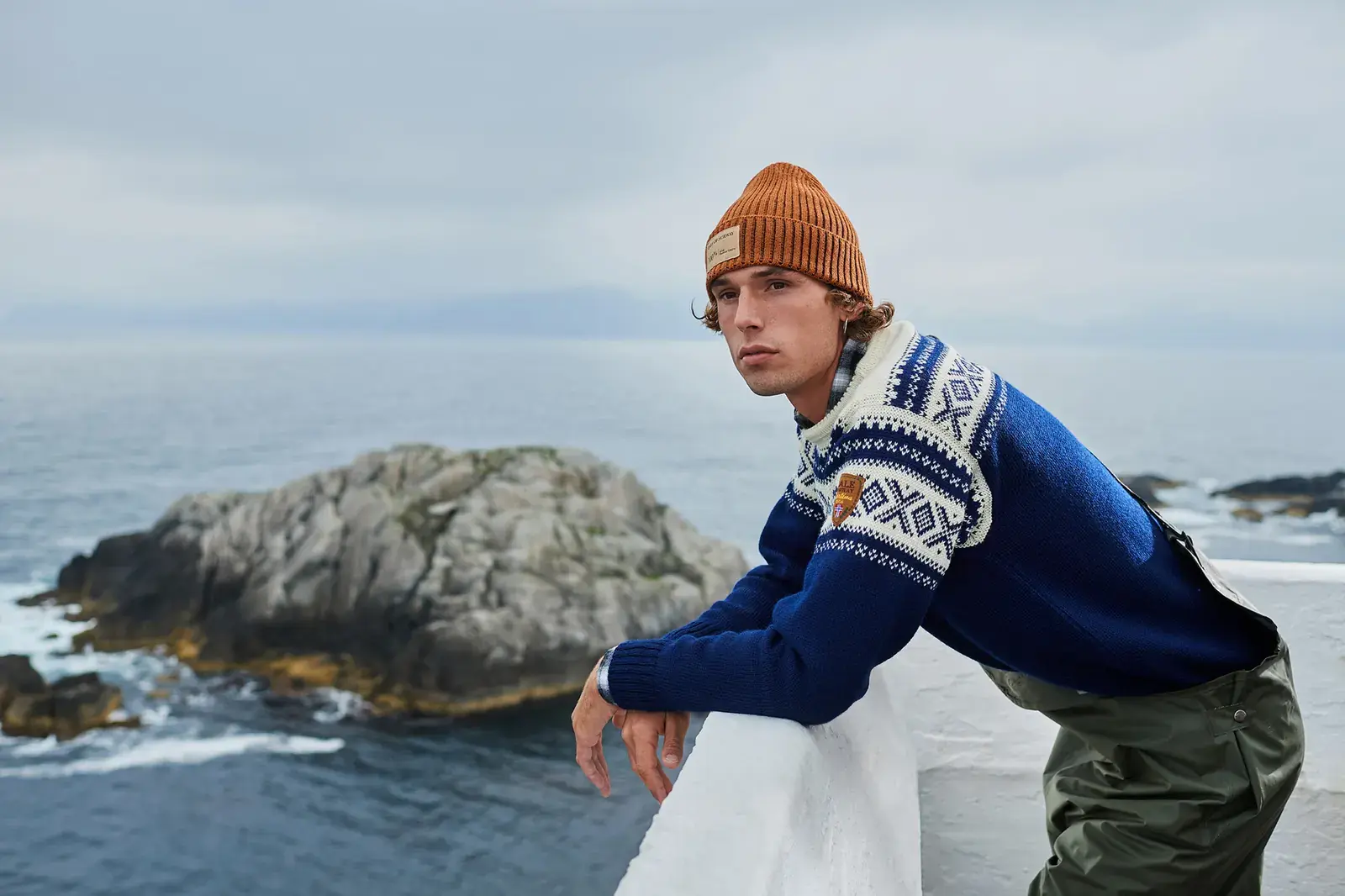
Powered by hydroelectricity from the Bergsdalselva river since 1879, Dale of Norway knits everything from rugged 33.5-micron mountain wool to 16.5-micron merino base layers. Here is how the yarns, windproof WP liners, sizing and care work.
The essentials at a glance
- 01
Industrial pioneer Peder Jebsen started the mill in the western Norwegian village of Dale on 22 August 1879. According to Dale of Norway, waterfalls feeding the Bergsdalselva river still power the knitting plant today.
- 02
Beginning with the 1956 Winter Olympics in Cortina d'Ampezzo, the brand has designed official sweaters for Norway's national ski teams across Winter Olympics and World Ski Championships.
- 03
Micron fiber diameter separates the lineup cleanly: rugged Norwegian wool (Plover, 33.5 microns) excels as a multi-decade outer layer, while Skinsoft merino (Zefir, 20.5 microns) and Pure (16.5 microns) sit itch-free against bare skin.
- 04
Garments carrying the WP (Weatherproof / Windproof) code pair water-repellent outer wool knitwear with a breathable windproof liner rated at an 8,000 mm water column.
Anyone who has ridden an exposed chairlift in a stiff mountain wind knows the gap between loose fashion knitwear and tightly spun Norwegian wool. Step inside a heated ski lodge twenty minutes later and you notice something else immediately: whether the collar touching your neck is crisp 33.5-micron mountain sheep's wool or soft 20.5-micron merino. Navigating that exact spectrum is the key to choosing the right piece from Dale of Norway.
Browse the lineup and you meet names steeped in ski history and Nordic geography: Cortina 1956, Setesdal, Lillehammer 1994, Vail, Moritz and Christiania, paired with yarn names such as Plover, Njord, Seagull, Zefir and Mokena plus the WP label. Behind those names lies a practical system of fiber diameter, knit density, cut and wind protection.
East of Bergen, the steep valley of Dale sits wedged between rocky mountainsides and western Norway's fjords. Traveling through the impoverished farming hamlet in 1872, Danish-born entrepreneur Peder Jebsen spotted the rushing Bergsdalselva river. In 1873 he purchased waterfall rights from local farmers, and on 22 August 1879 the turbines of Dale Fabrikker turned for the very first time.
According to Dale of Norway, local hydroelectric power from those surrounding waterfalls has driven production in Dale continuously for more than 145 years. One historical detail surprises many buyers: although the mill opened in 1879, Dale did not switch to industrial knitting machines until 1967. Throughout the 1950s and 1960s, hundreds of Norwegian housewives across the country hand-knitted the patterned sweaters to factory specifications.
Today, according to the manufacturer, knit panels are programmed and knitted on flat-knitting machines in Dale. To handle international demand under its own roof, the company established its wholly owned subsidiary Wool Group Poland in 2019, where around 120 specialists steam, assemble and inspect panels knitted in Dale. Traditional hardware and trims come from long-standing partners as well: Norwegian metalworker Tinn-Per casts the pewter clasps, west-coast weaver Møre Bånd & Vev produces the patterned ribbons, and yarn spinners including Südwolle Group and Schoeller supply fine worsted wools.
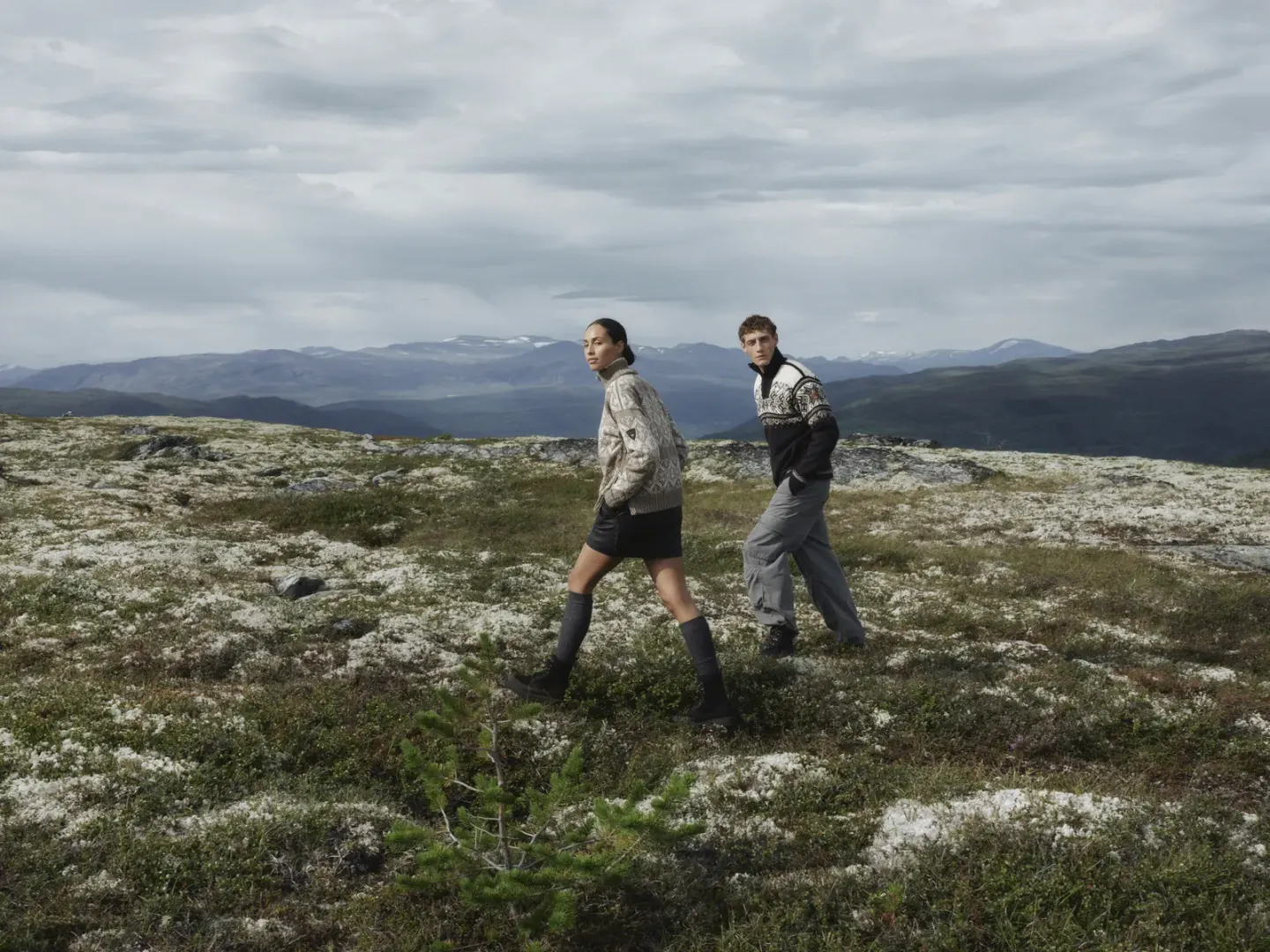
Competitive skiing made the patterns famous worldwide. Designer Bitten Eriksen created Norway's first official Olympic team sweater for the 1956 Winter Games in Cortina d'Ampezzo, followed two years later by the first World Championship sweater for Bad Gastein 1958. Every Winter Olympics and Alpine or Nordic World Ski Championship since has added a new chapter: Squaw Valley 1960, Innsbruck 1964, Vail 1989, Lillehammer 1994, St. Moritz 2003, Trondheim 2025 and Milano-Cortina 2026.
One number tells you more about how a wool sweater feels and wears than any marketing adjective: microns (thousandths of a millimeter). Micron count measures the diameter of an individual wool fiber. Below roughly 21 microns, fiber tips bend gently against skin receptors without prickling. Above 28 microns, fibers stay springy and crisp, trapping generous pockets of warm air while shrugging off abrasion from pack straps for decades.
Yarn ply (how many single strands are twisted together) and gauge (needles per inch) shape the garment further. Multi-color Norwegian jacquard patterns carry stranded floats across the inside of the knit, nearly doubling fabric loft compared with single-color jersey stitch.
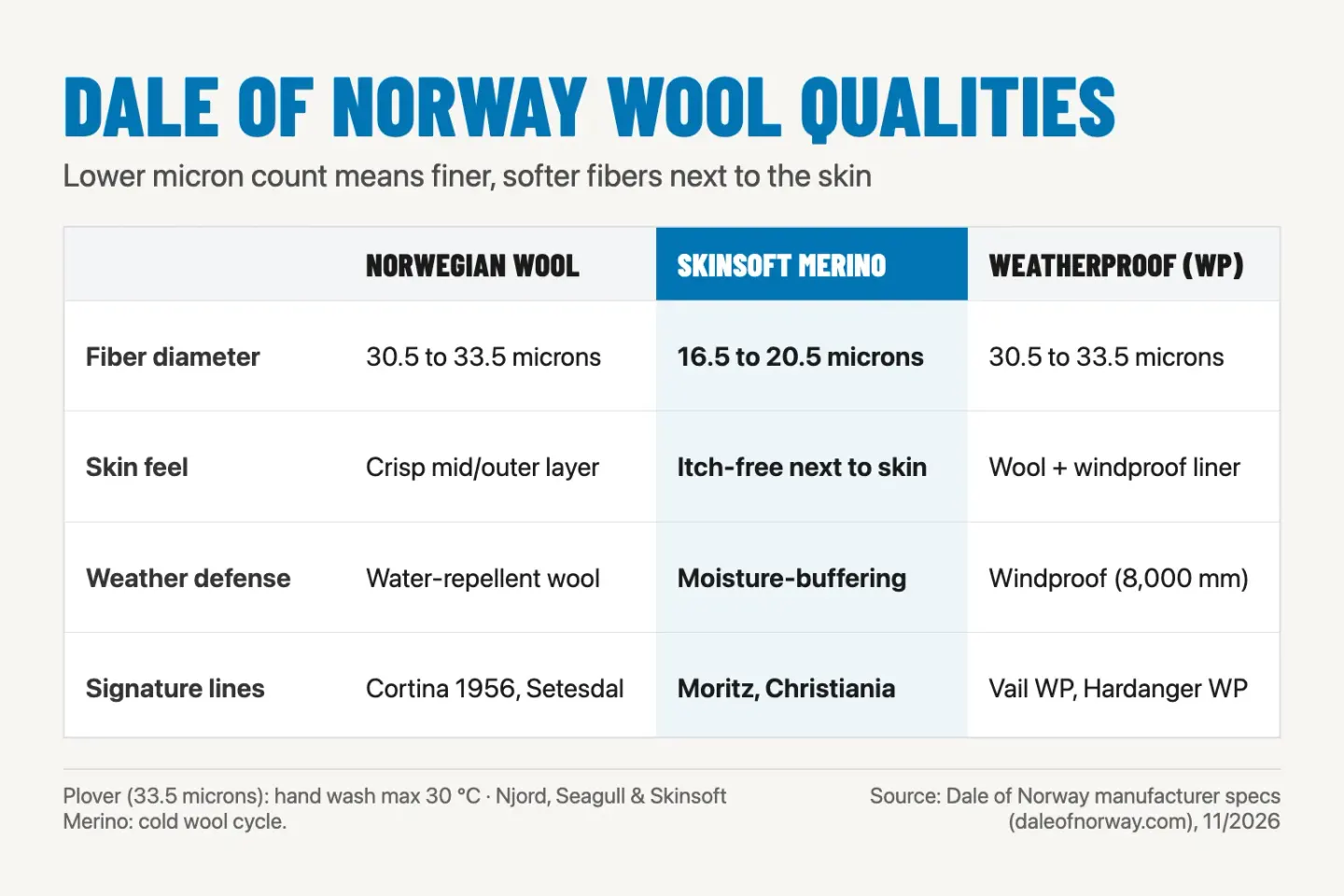
Norwegian sheep's wool (Plover & Njord) and lightweight Seagull wool
Sheep grazing freely across Norwegian mountain pastures grow wool with pronounced crimp, natural luster and strong resistance to pilling. Dale separates these heritage and crossbred yarns into three distinct weights:
- Plover (33.5 microns, 100% Norwegian wool): Used continuously by Dale since 1939, Plover has a crisp, structured hand feel built for a second or third layer over a shirt. It anchors the iconic Dale of Norway Cortina 1956 Uni Sweater and matching Cortina 1956 Hat. You also find robust Norwegian wool in the traditional Setesdal Uni Jacket with its classic lusekofte lice stitch, woven braid and pewter clasps, as well as the commemorative 140th Anniversary Masc Sweater and 140th Anniversary Fem Jacket. Note that Plover garments require cold hand washing.
- Njord (30.5 microns, 100% fine Norwegian wool): Spun from a Norwegian lamb's very first shearing. Shorter fibers create a lighter, softer knit that undergoes a natural salt treatment so you can wash it on a cold wool machine cycle.
- Seagull (27 microns, lightweight South American crossbred wool): Bridges rugged mountain wool and fine merino. Treated with natural salts for wool-cycle machine washing, Seagull powers versatile cabin and everyday favorites such as the 1994 Fem Sweater (and 1994 Masc Sweater), the Turin-inspired Peace Fem Sweater with its heart zipper pull and pewter buttons, and the Blyfjell Sweater trimmed with elk leather along the quarter-zip.
Skinsoft merino (Zefir, Air-Spun, Mokena & Pure)
If coarse wool bothers your neck or you want an athletic midlayer underneath a shell jacket, look straight to Dale's merino family. According to Dale of Norway, all merino wool in its collections comes from mulesing-free farms.
- Zefir Skinsoft merino (20.5 microns): Long-staple superwash merino spun for finely patterned ski sweaters and tailored cardigans. Originally created for the 2003 St. Moritz Alpine World Ski Championships, the Dale of Norway Moritz Fem Sweater uses a double-layer Comfort Knit with natural stretch. Rib-knitted ski classics like the Geilo Masc Sweater and Geilo Fem Sweater, the patterned Leknes Fem Sweater and the tailored Christiania Fem Jacket with its two-way front zip all rely on 20.5-micron Zefir merino.
- Air-spun merino (19.5 microns): In the Myking Fem Sweater and Myking Masc Sweater, fine merino fibers are air-spun around a thin polyamide core. You get chunky hand-knit loft at a fraction of traditional sweater weight.
- Mokena (19.5 microns) & Pure (16.5 microns) for base layers: Worn directly next to skin on cold piste or Nordic ski days, superfine merino powers first layers such as the Aksla Fem Baselayer Half Zip, Aksla Masculine Baselayer Crew Neck, Falkeberg Feminine Baselayer Half Zip and Vail Masculine Baselayer Crew Neck.
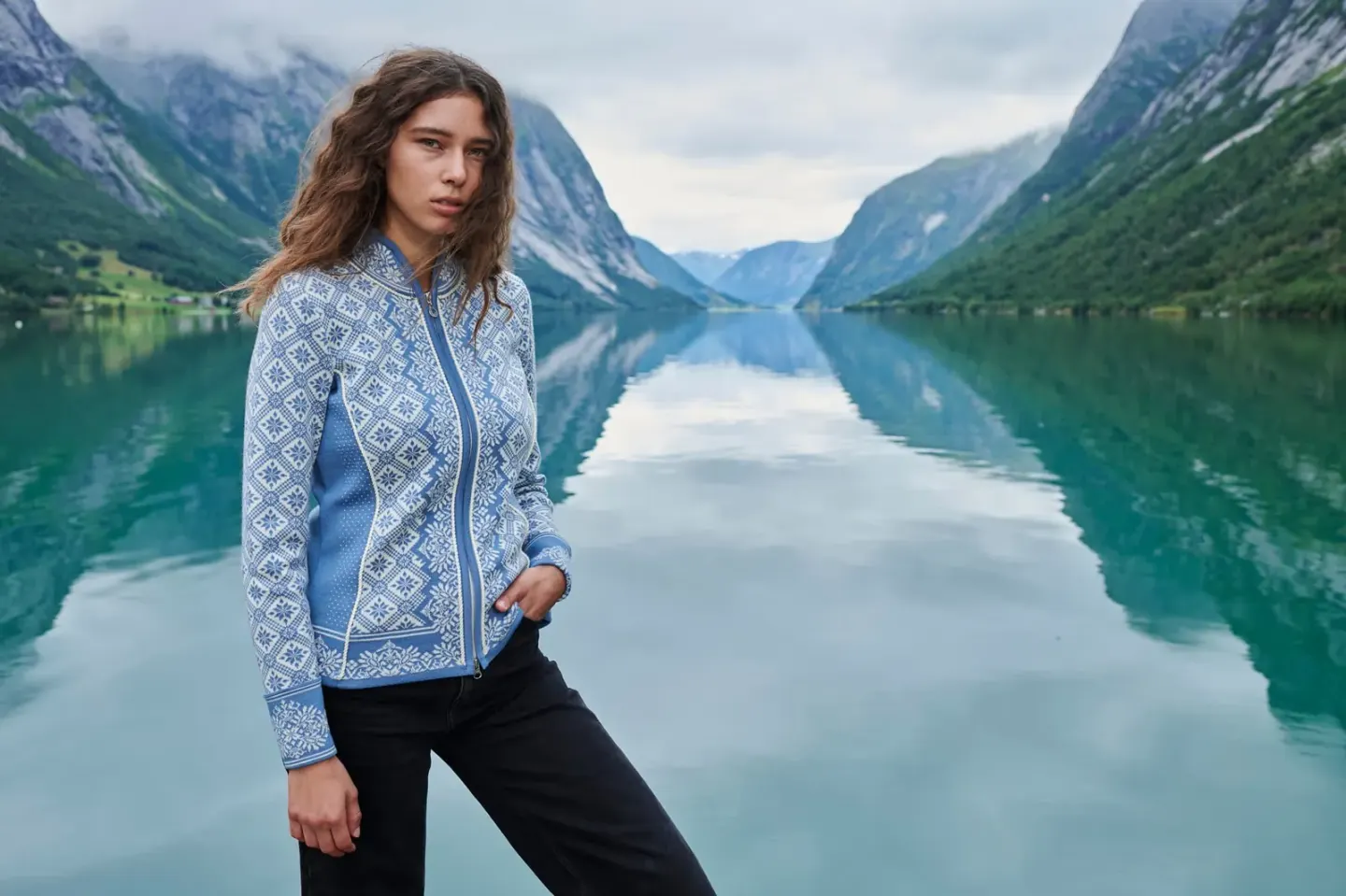
Unlined wool sweaters like the Dale of Norway Vail Masc Sweater, featuring the classic eight-petal Selburose and a fleece-lined high neck, insulate reliably in calm sub-zero air. Put that same sweater into a 40 km/h ridge wind or coastal gust, however, and cold air pushes straight through open knit loops.
Dale solves that problem with its Weatherproof and Windproof collection, marked by WP in the product name. On the outside sits water- and dirt-repellent Norwegian wool; sewn inside is a stretchy, breathable windproof membrane liner rated at an 8,000 mm water column. In dry frost, light snow flurries or brisk autumn winds, a WP sweater replaces a separate windbreaker.
You can pick between half-zip pullovers such as the Dale of Norway Vail WP Masc Sweater (complete with thumbhole wrist gaiters and a soft fleece collar) and full-zip jackets like the Hardanger WP Masc Jacket or the women's Vola WP Fem Jacket knitted in 30.5-micron Njord wool.
Five core Dale of Norway yarns compared
| Feature | Plover (Norwegian wool) | Njord (Lambswool) | Seagull (Lightweight)Skin-friendly | Zefir (Skinsoft merino) | Pure / Mokena (Merino) |
|---|---|---|---|---|---|
Fiber diameter | 33.5 microns | 30.5 microns | 27.0 microns | 20.5 microns | 16.5 to 19.5 microns |
Layering role | Mid or outer layer | Mid or outer layer | Lighter midlayer | Next-to-skin or midlayer | First layer (base layer) |
Care label | Hand wash (max 30 °C) | Cold wool cycle | Cold wool cycle | Cold wool cycle | Cold wool cycle |
Signature styles | Cortina 1956, Setesdal, Vail | Vola WP, archive styles | 1994, Peace, Blyfjell | Moritz, Geilo, Christiania | Aksla, Falkeberg, Vail Base |
Six core Dale of Norway picks from our range
From the 1956 Cortina icon and 1994 Lillehammer sweater to Skinsoft merino, WP wind protection and base layers
 Dale of NorwayCortina 1956 Uni SweaterThe original 1956 Olympic sweater knitted in 100% long-lasting Plover Norwegian wool (33.5 microns).234.05€View product →
 Dale of NorwayChristiania Fem JacketTailored women's cardigan in 20.5-micron Zefir Skinsoft merino wool with a two-way front zipper.333.45€View product →
 Dale of Norway1994 Fem SweaterUpdated Lillehammer 1994 Olympic design knitted in lighter, machine-washable Seagull wool (27 microns).287.65€View product →
 Dale of NorwayMoritz Fem SweaterSporty double-layer Comfort Knit ski midlayer made from 100% Skinsoft merino wool (20.5 microns).303.25€View product →
 Dale of NorwayVail WP Masc SweaterWater-repellent Norwegian wool sweater backed by a breathable windproof liner (8,000 mm water column).434.45€View product →
 Dale of NorwayAksla Feminine Baselayer Crew NeckLightweight, itch-free merino base layer built for active ski days and winter hikes.116.85€View product →
No single wool weight handles steep ski-touring climbs and icy city evenings equally well. Knowing where each yarn compromises saves frustration later.
Traditional 33.5-micron Plover wool in Cortina 1956 or Setesdal holds its shape for decades, yet feels noticeably crisp against bare wrists and collarbones. If you wear short sleeves underneath or stay indoors for hours, 20.5-micron Zefir merino (Moritz, Christiania, Geilo) or fleece-collared designs like Vail feel far gentler. Heavy multi-ply jacquard knits are also bulky and weighty when stuffed inside a daypack.
Windproof WP garments bring their own trade-off: while the internal membrane stops chairlift and coastal gusts cold, it slows down vapor transfer during steep uphill hikes compared with unlined wool. And because knitted outer seams are not tape-sealed like a hardshell rain jacket, prolonged downpours still call for a dedicated waterproof shell.
Matching the right Dale of Norway piece to your plans
- 1
If coarse wool irritates your neck or you wear sweaters indoors over light tops
choose Zefir Skinsoft merino (20.5 microns, e.g. Moritz, Geilo, Christiania) or airy Myking merino (19.5 microns).
- 2
If you want a hard-wearing outer sweater for dry sub-zero cold, cabin trips and everyday winter wear
pick 100% Plover Norwegian wool (33.5 microns) such as Cortina 1956 or Setesdal.
- 3
If you spend cold days in open wind on chairlifts, coastlines or autumn ridges without a shell
step up to a windproof-lined WP piece like Vail WP, Hardanger WP or Vola WP.
- 4
If you layer underneath a trim alpine ski jacket
choose a sleeker merino midlayer (Geilo, Moritz) or an Aksla base layer rather than a lofty multi-ply heritage sweater.
Right for you if …
Skiers, winter hikers and heritage knitwear fans who want to choose deliberately between rugged outer wool and itch-free merino
Probably not for you if …
Ultralight backcountry tourers counting every gram in a pack or multi-hour rainstorms without a hardshell
Dale of Norway builds its range around three distinct silhouettes: shaped women's cuts (Fem / Feminine), regular men's cuts (Masc / Masculine) and straight Unisex heritage cuts (Uni) with traditional T-shaped drop sleeves.
Women's tops span XS (EU 32, chest 82 cm), S (EU 34-36, 88 cm), M (EU 38-40, 94 cm), L (EU 42-44, 100 cm), XL (EU 46-48, 106 cm) and XXL (EU 50-52, 116 cm). Men's and Unisex sizing starts at XS (EUR 40-42, chest 88 cm) and runs through S (44-46, 94 cm), M (48-50, 100 cm), L (52-54, 106 cm), XL (56-58, 112 cm) and XXL (60-62, 118 cm) up to XXXL (64-66, 124 cm).
Two fit details matter in practice:
- Unisex sweaters run larger for women: Because Cortina 1956 Uni Sweater and Setesdal Uni Jacket follow the men's/unisex size chart, women typically size down one full size compared with their usual Feminine-cut size.
- WP liners reduce knit stretch: The sewn-in windproof liner gives less when pulling a pullover over your shoulders than unlined wool. If you sit between sizes or layer thicker shirts underneath, size up on WP pullovers or pick a full-zip WP jacket.
On garment care, longtime Dale of Norway quality controller Gro Eide points out after more than 30 years on the job that washing wool too often and too warm causes most damage. Dale recommends six straightforward habits:
- Air out more, wash less: Wool's natural fiber scales resist odor on their own. Hang your sweater outside overnight or in a steamy bathroom between wears, and dab small spots gently with a damp cloth instead of washing the whole piece.
- Check the sewn-in care label first: Plover (33.5 microns) and undyed wool require cold hand washing up to 30 °C (squeeze gently, never wring). Njord, Seagull, Zefir, Mokena and Pure yarns can go on a cold wool machine cycle with pH-neutral wool detergent.
- Skip fabric softener and tumble dryers: Softeners and bleach weaken wool fibers, while dryer heat causes shrinkage.
- Dry flat and store folded: Reshape damp knitwear flat on a towel away from direct radiators. Never hang wet wool, and store dry sweaters folded flat in a closet (sealed against moths off-season) rather than on coat hangers that stretch the shoulders.
Explore the full Dale of Norway collection
From Cortina 1956 and Lillehammer 1994 Olympic sweaters to Skinsoft merino cardigans, base layers, windproof WP knitwear, hats and socks.
Shop all Dale of Norway productsFrequently asked questions
Where are Dale of Norway sweaters made?
According to Dale of Norway, designs are developed and knit panels are knitted at its historic mill in the village of Dale in western Norway, powered by local hydroelectric waterfalls from the Bergsdalselva river. Since 2019, its wholly owned subsidiary Wool Group Poland (around 120 employees) also steams, assembles and finishes panels knitted in Dale.
Do Dale of Norway sweaters feel itchy against the skin?
That depends directly on the yarn's micron rating. Heritage sweaters knitted in 100% Plover Norwegian wool (33.5 microns, such as Cortina 1956 or Setesdal) have a crisp, rugged texture intended to be worn over a base shirt. Sweaters in Zefir Skinsoft merino (20.5 microns, such as Moritz, Geilo or Christiania) and merino base layers (16.5 to 19.5 microns) feel soft and itch-free directly against bare skin.
What does WP (Weatherproof / Windproof) mean on Dale of Norway knitwear?
WP marks windproof-lined outerwear knitwear. Dale pairs water- and dirt-repellent outer Norwegian wool with a breathable windproof membrane liner rated at an 8,000 mm water column. That blocks cold gusts on chairlifts, ridges and coastlines without needing an extra wind shell in dry weather.
How do Dale of Norway Unisex sweaters fit women?
Unisex classics like the Cortina 1956 Uni Sweater and Setesdal Uni Jacket follow the straight-cut men's/unisex size chart (for instance, size S corresponds to EUR 44-46 or a 94 cm chest). Women normally choose one size smaller in Unisex models than in tailored Feminine cuts.
Can I machine-wash a Dale of Norway sweater?
Always check the sewn-in care label first. Traditional Plover Norwegian wool (33.5 microns) must be hand-washed cold at up to 30 °C. Garments knitted from Njord (30.5 microns), Seagull (27 microns) and all Skinsoft merino lines (Zefir, Mokena, Pure) can be washed on a cold wool machine cycle using wool detergent without fabric softener, then dried flat on a towel.
Sources (6)
- Dale of Norway: Company history since 1879 ↗
- Dale of Norway: Our factory in Dale & Wool Group Poland ↗
- Dale of Norway: Official wool & micron guide (Plover, Njord, Seagull, Zefir, Pure) ↗
- Dale of Norway: Official Olympic sweaters since Cortina 1956 ↗
- Dale of Norway: Windproof & Weatherproof collection ↗
- Dale of Norway: Wool care instructions ↗

SportFits editorial team
Marketing & Sales Manager at SportFitsNiklas is Marketing & Sales Manager at SportFits and studied applied sports science in Regensburg. In the magazine he writes about training science, fitness and longevity, putting trends into scientific context instead of simply celebrating them. He also looks at what really matters in outdoor gear: honest facts instead of empty advertising language.
Author profile →SportFits
outdoors looks good on you