Stories
Didriksons: Weather protection, Galon and warmth levels explained
In partnership withDidriksons

Since 1913, Didriksons has been making weather protection for the coast and everyday life. Find out when PVC-free Galon is better than a breathable shell, how warmth levels and Extend Size work, and what to consider with USX sizing.
The essentials at a glance
- 01
Didriksons comes from the Swedish fishing village of Grundsund (1913) and continues to focus on windproof and waterproof parkas, rain jackets and children's clothing without animal down.
- 02
Galon® (PU-coated, taped seams, 5,000 to 8,000 mm) never needs reproofing, but does not let water vapour through: useful in rain and with little movement, unsuitable for strenuous exercise.
- 03
Woven shells and parkas reach 5,000 to 15,000 mm according to the manufacturer, tested to DIN EN ISO 811, are vapour-permeable and have used PFC-free finishes since 2015.
- 04
Three warmth levels (shell without insulation, 100 to 140 g/m², 160 to 250 g/m²) and Extend Size in children's clothing make it easier to choose according to temperature and growth.
When it rains on Sweden's west coast, the water rarely falls vertically. Wind drives it through every open seam. That is exactly the weather Julius and Hanna Didrikson designed their first workwear for fishermen for in Grundsund in 1913. Today, you will find Didriksons on the commute in the city as well as in the playground or on an autumn walk along the coast.
Before buying, the same four questions almost always come up. When is the famous Galon® material worthwhile, and when will it make you sweat too much? How warm is an uninsulated parka compared with a 250-g/m² winter model? How does Extend Size work in children's coveralls? And how do the straight-cut USX unisex sizes fit? Here you will find the answers based on the manufacturer's data and our experience with the range.
Hanna grew up in a fishing family on the island of Grötö near Gothenburg, while Julius grew up in Grundsund further north on the west coast. Both had lost relatives at sea. According to the company chronicle, in 1910 more Swedish fishermen died from hypothermia and related illnesses caused by poor clothing than from drowning. Three years later, Hanna and Julius coated sturdy fabrics with oils, made them resistant to spray and persistent rain, and founded the Didriksons Regnklädesfabrik.
Product design and patterns are still created at the Swedish headquarters in Borås, where around 110 employees work, supported by a small six-person office in Asia that works with production partners. The brand remains committed to one principle: functional weather protection for everyday outdoor use, with clean cuts and no unnecessary gimmicks.
Didriksons also follows a firm policy regarding the insulation. According to the manufacturer, its warm fillings contain no animal-derived materials; most insulated jackets and parkas use loose, recycled synthetic fibres. For some synthetic fabrics, the brand uses the so-called Solution-Dye process, in which the pigment is incorporated during yarn production rather than added in a subsequent dye bath.
Waterproof does not mean the same thing across all Didriksons products. The brand takes a two-track approach: classic coated Galon® on the one hand, and woven performance fabrics with a vapour-permeable membrane or coating and PFC-free DWR (Durable Water Repellent, a water-repellent surface finish) on the other. Knowing the difference helps you avoid the most common poor purchase.
What DIN EN ISO 811 actually measures
Didriksons tests waterproof materials according to DIN EN ISO 811. In the laboratory, a testing device steadily presses more water against a clamped fabric sample from below until droplets penetrate at three points. The pressure at the third droplet gives the hydrostatic head in millimetres.
However, the standard has limitations. It measures only new fabric under static pressure and says nothing about the seams or vapour permeability. For practical use, the combination of fabric and seam construction is decisive: at Didriksons, all seams on waterproof models are taped or welded, so no water can enter through needle holes. You can read more about how to interpret millimetre ratings in our article Hydrostatic head: what the figure says about jackets.
Galon® versus woven shell in direct comparison
Galon® consists of a closed PU (polyurethane) coating on a carrier fabric, joined with welded seams without needle holes. In the mid-20th century, Didriksons adopted the material for rainwear and acquired the trademark rights in the early 2000s. The main advantage is clear: according to the manufacturer, Galon® withstands 5,000 to 8,000 mm, can simply be wiped clean with a damp cloth and never needs reproofing.
That is also where the drawback lies. Because the PU layer is closed, Galon® does not allow water vapour to pass from the inside to the outside. At high speed or uphill, condensation forms under the jacket and you cool down. Mechanical ventilation openings under protected yokes reduce this effect somewhat, but they do not replace a breathable membrane.
Galon® vs woven Didriksons shell
| Criterion | Galon® (PU coating) | Woven shell & parkasAllrounder |
|---|---|---|
Hydrostatic head (EN ISO 811, manufacturer's specification) | 5,000 to 8,000 mm | 5,000 to 15,000 mm |
Seam construction | Welded (without needle holes) | Taped or welded |
Vapour permeability | None (mechanical vents only) | Breathable (e.g. 4,000 to 15,000 g/m²/24h) |
Reproofing needed? | No | Yes, when water repellency decreases (PFC-free) |
Best use | Nursery, playground, walking, rain breaks | Commuting, brisk walking, everyday use, light tours |

For women's and men's models, insulation is just as important as weather protection. Didriksons therefore divides autumn and winter jackets into three clear warmth levels. This prevents you from sweating in a thick Polar parka in October or freezing in a shell-only jacket in January.
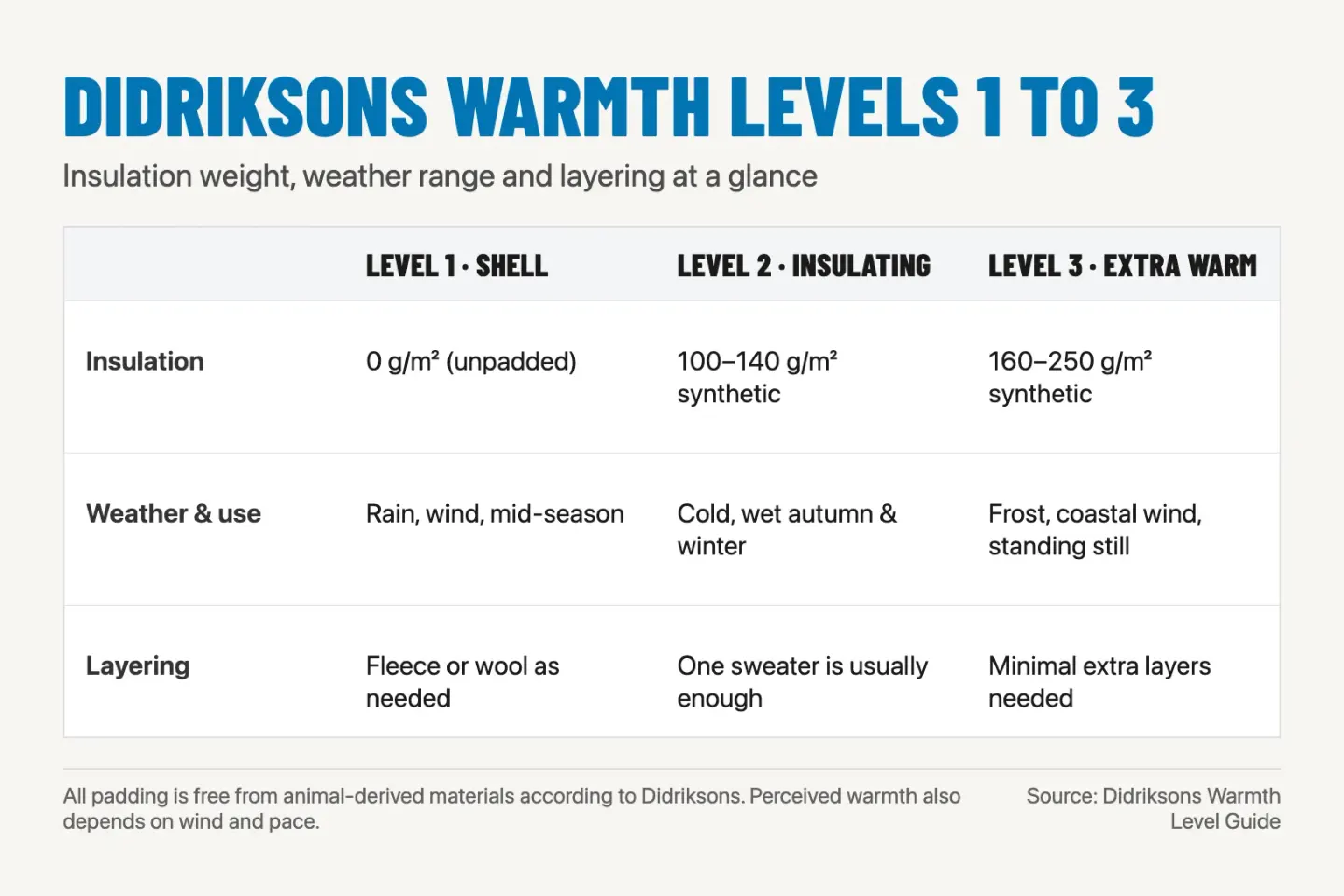
Level 1 (Shell) contains no insulation. Models such as the Ilma WNS Parka 8 (10,000 mm hydrostatic head, 10,000 g/m²/24h breathability, two-way zip) or the sportier Dario USX Jacket 2 in polyamide Taslan with 15,000 mm are your choice for three seasons. You control the warmth yourself with fleece or a wool jumper underneath.
Level 2 (Insulating, 100 to 140 g/m²) covers a typical Central European autumn and winter in the city. The Felia WNS Parka uses 140 g/m² insulation made from 100% recycled fibres; among the unisex jackets, the Stefan USX Jacket has 120 g/m² and 10,000 mm. A thin midlayer is usually all you need.
Level 3 (Highly Insulating, 160 to 250 g/m²) is designed for bitter cold, icy wind or long periods with little movement, for example on the sidelines or while waiting on a platform. The Tempest USX Parka combines 250 g/m² recycled polyester insulation with a 15,000 mm hydrostatic head and 15,000 g/m²/24h breathability. You can find a comprehensive overview of all construction features of warm winter clothing in the Winter jacket guide.
Selected Didriksons models from our range
From the uninsulated transitional parka and 250-g/m² winter warmth to a children's coverall that grows with them
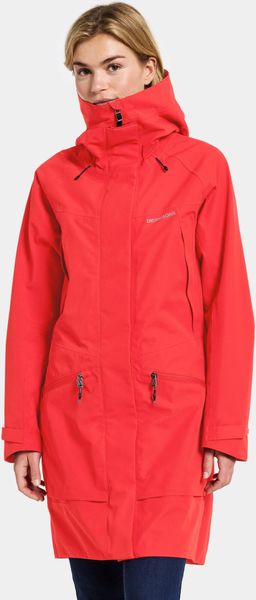 DidriksonsIlma WNS Parka 8Uninsulated women's parka (Level 1) with 10,000 mm and a two-way zip.220.75€View product →
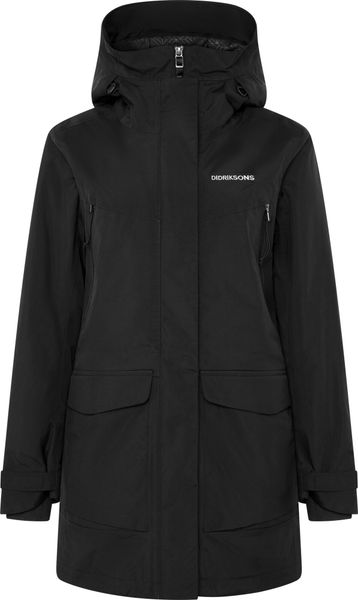 DidriksonsFelia WNS ParkaWomen's winter parka (Level 2) with 140 g/m² insulation made from recycled fibres.203.85€View product →
 DidriksonsRick USX Parka 2Straight-cut unisex winter parka (10,000 mm) with sealed seams and detachable faux fur.207.65€View product →
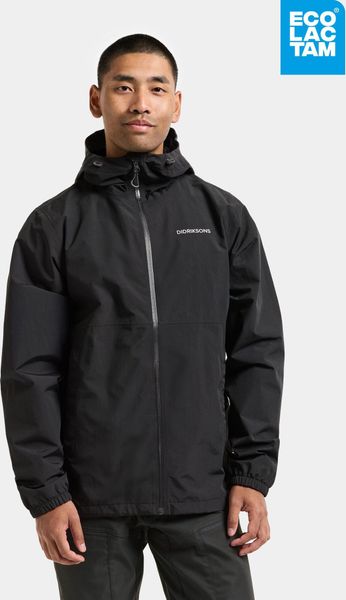 DidriksonsDario USX Jacket 2Uninsulated shell (15,000 mm, 15,000 g/m²/24h) made from polyamide Taslan.95.85€View product →
 DidriksonsFalken K CoverallChildren's coverall (6,000 mm) with Extend Size on the sleeves and legs plus silicone foot straps.98.65€View product →
 DidriksonsSlaskeman Kids SET 4Children's rain set made from PVC-free Galon (8,000 mm) with welded seams.55.15€View product →
Children often outgrow jackets before the material gives way. This is where Extend Size comes in: many children's jackets, trousers and coveralls have a clearly visible red safety seam inside the sleeves and trouser legs. If you carefully undo this seam with a seam ripper, the sleeves and legs gain roughly a full clothing size in length.
This noticeably changes the buying rule. Parents tend to buy children's clothing one size too large as a precaution. Didriksons explicitly advises against this: if your child is between two sizes, choose the smaller one. Overly loose coveralls restrict climbing and running, children move less and get cold more quickly.
The range shows the division very clearly: for continuous rain on the playground, a PVC-free Galon set such as the Slaskeman Kids Set 4 (8,000 mm, wipe-clean) is hard to beat. For active days in the woods or snow, breathable models with Extend Size offer more comfort, such as the Falken K Coverall (6,000 mm), the insulated Bjärven KDS Cover 5 with snow skirt, or the uninsulated children's trousers Dusk Kids Pants 7 with 15,000 mm and reinforced knees. Practical for nursery and siblings: many items have a multi-line name label for passing them on, and worn-through silicone foot straps can be bought as a replacement kit.

Didriksons uses three separate sizing systems. Women's models (abbreviation WNS) run in EU sizes 32 to 52, corresponding to German clothing sizes. Children's clothing is based on body height from 80 to 170 cm. Men's and unisex models, on the other hand, carry the abbreviation USX and follow international sizes from XS to XXXL.
USX means a straight, rather generous unisex cut based on men's measurements. Women choosing a USX model should use a tape measure: use your chest measurement or, with narrow shoulders and wider hips, your hip measurement in our Didriksons size chart. If you want a shaped fit, stick to the WNS models in EU sizes.
Wash and reproof correctly
Since 2015, Didriksons has, according to its own information, completely avoided fluorinated chemicals (PFC/PFAS) in its water-repellent surface finishes. The German Environment Agency points out that PFAS barely break down in nature and enter waterways through production and household washing. PFC-free finishes require slightly more careful care in return, because dirt and skin oils reduce water repellency more quickly.
If the outer fabric absorbs water, your jacket is not yet ruined. The waterproof membrane underneath will initially remain watertight; only the wet outer fabric feels heavier and colder. These five steps help the performance last for many seasons:
Close fasteners and turn inside out
Close all zips, buttons, buckles and hook-and-loop fasteners before washing, and turn the jacket inside out. This protects the coating from mechanical friction in the drum.
Choose mild detergent without fabric softener
Use a mild liquid detergent and the temperature stated on the care label. Fabric softener is forbidden because it immediately weakens the water-repellent finish.
Remove immediately and air-dry
Do not leave washed weatherproof clothing damp in the machine. Regular tumble-drying unnecessarily wears out the material.
Reactivate water repellency with heat or reproof with a PFC-free product
Short exposure to low heat according to the care label (light ironing or a few minutes in the tumble dryer) refreshes many PFC-free finishes. If water no longer beads afterwards, apply a PFC-free reproofing product. Detailed instructions are available in Washing and reproofing a rain jacket.
Treat Galon® differently and store it correctly
It is best to wipe Galon® clean with a damp cloth or wash it at 40 °C without a tumble dryer or drying cabinet. Store Galon® items hanging or flat rather than tightly folded, and not in hot lofts or damp cellars, as heat and major fluctuations in humidity age the PU material.
An honest point about longevity: Didriksons does not operate its own sewing or repair service. If something tears, the manufacturer provides a Fabric Repair Kit with two patches and glue, as well as selected spare parts such as buckles, buttons, zips and foot straps on request.
Didriksons is strongest in wet and cold everyday conditions between autumn storms, the commute and family weekends. Longer parka cuts cover the thighs and bottom, two-way zips provide room when cycling or getting in, and the synthetic insulation keeps you warm reliably even in high humidity.
That is also where the brand's limitation lies. For strenuous alpine high-altitude tours, trail running or backpacking trips where every gram and minimal pack size count, classic Didriksons parkas are too heavy and bulky. A lightweight three-layer hardshell is a better choice there.
Decision guide: is Didriksons right for your needs?
- 1
If you move calmly in continuous rain (walking, nursery, playground)
choose Galon® (5,000 to 8,000 mm): completely wipe-clean and never needs reproofing.
- 2
If you walk briskly, commute or move around outdoors a lot
choose a woven, vapour-permeable shell (10,000 to 15,000 mm) instead of Galon®.
- 3
If you want one jacket for autumn, winter and spring
choose warmth level 1 (shell) and control warmth with a midlayer.
- 4
If you want to cover frost and wind without thick layers underneath
go straight for warmth level 2 (100 to 140 g/m²) or level 3 (160 to 250 g/m²).
- 5
If your child is between two sizes
choose the smaller size in models with Extend Size rather than sizing up for growth.
Right for you if …
Everyday use in the rain, windy coasts, commuting in the city and families looking for robust, weatherproof parkas and children's clothing that grows with them.
Probably not for you if …
Ultralight mountaineering, strenuous trail running or anyone who needs a tiny, packable alpine three-layer hardshell for their rucksack.
The current Didriksons range at SportFits
From women's and men's parkas and breathable shells to Galon rain sets and children's coveralls with Extend Size, you can find all available lines on our Didriksons brand page.
View all Didriksons modelsBefore you choose a line or size, the five most common practical questions from our Buying advice can help.
Frequently asked questions
Is every Didriksons jacket automatically made from Galon®?
No. Galon® is just one line made from PU-coated fabric with welded seams (5,000 to 8,000 mm), mainly for classic raincoats and children's muddy-weather clothing. Most parkas and outdoor jackets are made from woven, vapour-permeable performance fabrics with a hydrostatic head of 5,000 to 15,000 mm.
What hydrostatic head is enough for heavy, continuous rain with Didriksons?
For everyday use, 5,000 to 10,000 mm according to DIN EN ISO 811 is easily sufficient with properly taped or welded seams. If you also often carry a heavy rucksack or kneel in wet conditions, models with 15,000 mm such as the Dario USX Jacket 2 or Dusk Kids Pants 7 offer more reserve.
Does Didriksons use real down in winter parkas?
No. According to the manufacturer, Didriksons insulation contains no animal-derived materials. The warmer jackets and parkas use synthetic fibres, mainly loose, recycled synthetic fibres.
How do I undo the Extend Size seam in children's clothing?
Turn the sleeve or trouser leg inside out and look for the colour-marked red inner seam. Carefully undo the red thread with a seam ripper or small nail scissors without cutting into the main fabric. This lengthens the item by approximately one full size.
How do Didriksons sizes compare with standard EU sizes?
Women's models (WNS) generally correspond to your usual German EU sizes (32 to 52). Unisex models (USX) have a straight, wider cut; between two sizes, the manufacturer recommends the smaller size for a closer fit and the larger size if you want room for thick jumpers.
Sources (9)
- Didriksons: Our history (founded 1913, Borås, materials) ↗
- Didriksons: A waterproof story (EN ISO 811, water column, PFC-free since 2015) ↗
- Didriksons: The guide to Galon® (PU coating, care and storage) ↗
- Didriksons: Warmth level guide (levels 1 to 3) ↗
- Didriksons: Extend Size — One garment, two sizes ↗
- Didriksons: Care advice & FAQ (washing, reproofing, repair kit, spare parts) ↗
- DIN Media: DIN EN ISO 811:2018-08 — Hydrostatic pressure test ↗
- German Environment Agency (UBA): PFAS in the textile industry ↗
- Verbraucherzentrale NRW: Outdoor clothing without microplastics and pollutants ↗
SportFits editorial team
Marketing & Sales Manager at SportFitsNiklas is Marketing & Sales Manager at SportFits and studied applied sports science in Regensburg. In the magazine he writes about training science, fitness and longevity, putting trends into scientific context instead of simply celebrating them. He also looks at what really matters in outdoor gear: honest facts instead of empty advertising language.
Author profile →SportFits
outdoors looks good on you